Close Menu
  • Home
  • News
  • Cyber Security
  • Internet of Things
  • Tips and Advice

Subscribe to Updates

Get the latest creative news from FooBar about art, design and business.

What's Hot

Malicious VS Code Extensions Deploy Advanced Infostealer

December 10, 2025

ShadyPanda Turns Popular Browser Extensions with 4.3 Million Installs Into Spyware

December 10, 2025

Hot CVEs, npm Worm Returns, Firefox RCE, M365 Email Raid & More

December 9, 2025
Facebook X (Twitter) Instagram
Wednesday, December 10
Facebook X (Twitter) Instagram Pinterest Vimeo
Cyberwire Daily
  • Home
  • News
  • Cyber Security
  • Internet of Things
  • Tips and Advice
Cyberwire Daily
Home»News»Bloody Wolf Expands Java-based NetSupport RAT Attacks in Kyrgyzstan and Uzbekistan
News

Bloody Wolf Expands Java-based NetSupport RAT Attacks in Kyrgyzstan and Uzbekistan

Team-CWDBy Team-CWDDecember 7, 2025No Comments3 Mins Read
Share Facebook Twitter Pinterest LinkedIn Tumblr Reddit Telegram Email
Share
Facebook Twitter LinkedIn Pinterest Email


The threat actor known as Bloody Wolf has been attributed to a cyber attack campaign that has targeted Kyrgyzstan since at least June 2025 with the goal of delivering NetSupport RAT.

As of October 2025, the activity has expanded to also single out Uzbekistan, Group-IB researchers Amirbek Kurbanov and Volen Kayo said in a report published in collaboration with Ukuk, a state enterprise under the Prosecutor General’s office of the Kyrgyz Republic. The attacks have targeted finance, government, and information technology (IT) sectors.

“Those threat actors would impersonate the [Kyrgyzstan’s] Ministry of Justice through official looking PDF documents and domain names, which in turn hosted malicious Java Archive (JAR) files designed to deploy the NetSupport RAT,” the Singapore-headquartered company said.

“This combination of social engineering and accessible tooling allows Bloody Wolf to remain effective while keeping a low operational profile.”

Bloody Wolf is the name assigned to a hacking group of unknown provenance that has used spear-phishing attacks to target entities in Kazakhstan and Russia using tools like STRRAT and NetSupport. The group is assessed to be active since at least late 2023.

The targeting of Kyrgyzstan and Uzbekistan using similar initial access techniques marks an expansion of the threat actor’s operations in Central Asia, primarily impersonating trusted government ministries in phishing emails to distribute weaponized links or attachments.

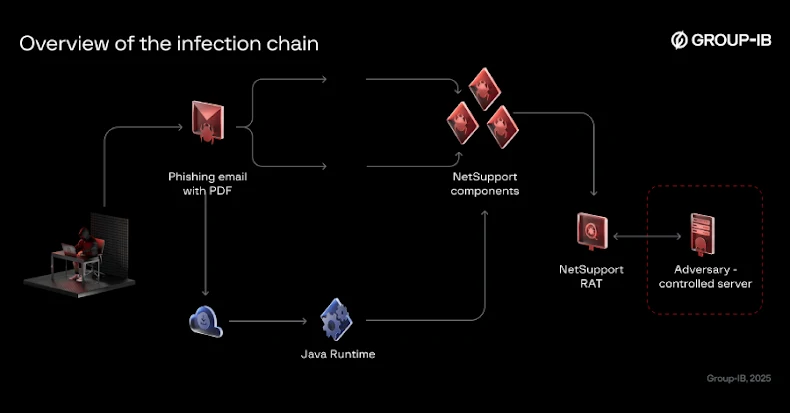
The attack chains more or less follow the same approach in that the message recipients are tricked into clicking on links that download malicious Java archive (JAR) loader files along with instructions to install Java Runtime.

While the email claims the installation is necessary to view the documents, the reality is that it’s used to execute the loader. Once launched, the loader then proceeds to fetch the next-stage payload (i.e., NetSupport RAT) from infrastructure that’s under the attacker’s control and set up persistence in three ways –

  • Creating a scheduled task
  • Adding a Windows Registry value
  • Dropping a batch script to the folder “%APPDATA%MicrosoftWindowsStart MenuProgramsStartup”

The Uzbekistan phase of the campaign is notable for incorporating geofencing restrictions, thereby causing requests originating outside of the country to be redirected to the legitimate data.egov[.]uz website. Requests from within Uzbekistan have been found to trigger the download of the JAR file from an embedded link within the PDF attachment.

Group-IB said the JAR loaders observed in the campaigns are built with Java 8, which was released in March 2014. It’s believed that the attackers are using a bespoke JAR generator or template to spawn these artifacts. The NetSupport RAT payload is a old version of NetSupport Manager from October 2013.

“Bloody Wolf has demonstrated how low-cost, commercially available tools can be weaponized into sophisticated, regionally targeted cyber operations,” it said. “By exploiting trust in government institutions and leveraging simple JAR-based loaders, the group continues to maintain a strong foothold across the Central Asian threat landscape.”


Source

computer security cyber attacks cyber news cyber security news cyber security news today cyber security updates cyber updates data breach hacker news hacking news how to hack information security network security ransomware malware software vulnerability the hacker news
Share. Facebook Twitter Pinterest LinkedIn Tumblr Email
Previous ArticleMicrosoft to Block Unauthorized Scripts in Entra ID Logins with 2026 CSP Update
Next Article MS Teams Guest Access Can Remove Defender Protection When Users Join External Tenants
Team-CWD
  • Website

Related Posts

News

Malicious VS Code Extensions Deploy Advanced Infostealer

December 10, 2025
News

ShadyPanda Turns Popular Browser Extensions with 4.3 Million Installs Into Spyware

December 10, 2025
News

Hot CVEs, npm Worm Returns, Firefox RCE, M365 Email Raid & More

December 9, 2025
Add A Comment
Leave A Reply Cancel Reply

Latest News

macOS Stealer Campaign Uses “Cracked” App Lures to Bypass Apple Securi

September 7, 202512 Views

North Korean Hackers Exploit Threat Intel Platforms For Phishing

September 7, 20256 Views

U.S. Treasury Sanctions DPRK IT-Worker Scheme, Exposing $600K Crypto Transfers and $1M+ Profits

September 5, 20256 Views

Ukrainian Ransomware Fugitive Added to Europe’s Most Wanted

September 11, 20255 Views

The risks of unsupported IoT tech

September 11, 20255 Views
Stay In Touch
  • Facebook
  • YouTube
  • TikTok
  • WhatsApp
  • Twitter
  • Instagram
Most Popular

macOS Stealer Campaign Uses “Cracked” App Lures to Bypass Apple Securi

September 7, 202512 Views

North Korean Hackers Exploit Threat Intel Platforms For Phishing

September 7, 20256 Views

U.S. Treasury Sanctions DPRK IT-Worker Scheme, Exposing $600K Crypto Transfers and $1M+ Profits

September 5, 20256 Views
Our Picks

In memoriam: David Harley

November 12, 2025

Why the tech industry needs to stand firm on preserving end-to-end encryption

September 12, 2025

The WhatsApp screen-sharing scam you didn’t see coming

November 6, 2025

Subscribe to Updates

Get the latest news from cyberwiredaily.com

Facebook X (Twitter) Instagram Pinterest
  • Home
  • Contact
  • Privacy Policy
  • Terms of Use
  • California Consumer Privacy Act (CCPA)
© 2025 All rights reserved.

Type above and press Enter to search. Press Esc to cancel.