Close Menu
  • Home
  • News
  • Cyber Security
  • Internet of Things
  • Tips and Advice

Subscribe to Updates

Get the latest creative news from FooBar about art, design and business.

What's Hot

ServiceNow AI Agents Can Be Tricked Into Acting Against Each Other via Second-Order Prompts

November 28, 2025

Threat Actors Exploit Calendar Subscriptions for Phishing and Malware

November 28, 2025

Fortinet Warns of New FortiWeb CVE-2025-58034 Vulnerability Exploited in the Wild

November 28, 2025
Facebook X (Twitter) Instagram
Friday, November 28
Facebook X (Twitter) Instagram Pinterest Vimeo
Cyberwire Daily
  • Home
  • News
  • Cyber Security
  • Internet of Things
  • Tips and Advice
Cyberwire Daily
Home»News»Fortinet Warns of New FortiWeb CVE-2025-58034 Vulnerability Exploited in the Wild
News

Fortinet Warns of New FortiWeb CVE-2025-58034 Vulnerability Exploited in the Wild

Team-CWDBy Team-CWDNovember 28, 2025No Comments3 Mins Read
Share Facebook Twitter Pinterest LinkedIn Tumblr Reddit Telegram Email
Share
Facebook Twitter LinkedIn Pinterest Email


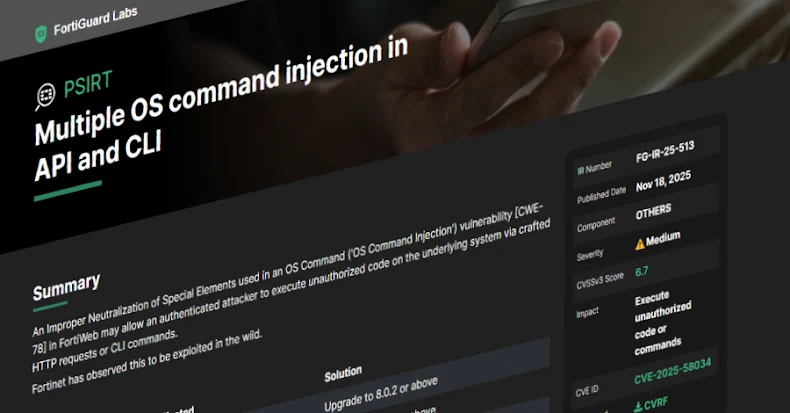
Fortinet has warned of a new security flaw in FortiWeb that it said has been exploited in the wild.

The medium-severity vulnerability, tracked as CVE-2025-58034, carries a CVSS score of 6.7 out of a maximum of 10.0.

“An Improper Neutralization of Special Elements used in an OS Command (‘OS Command Injection’) vulnerability [CWE-78] in FortiWeb may allow an authenticated attacker to execute unauthorized code on the underlying system via crafted HTTP requests or CLI commands,” the company said in a Tuesday advisory.

In other words, successful attacks require an attacker to first authenticate themselves through some other means and chain it with CVE-2025-58034 to execute arbitrary operating system commands.

It has been addressed in the following versions –

  • FortiWeb 8.0.0 through 8.0.1 (Upgrade to 8.0.2 or above)
  • FortiWeb 7.6.0 through 7.6.5 (Upgrade to 7.6.6 or above)
  • FortiWeb 7.4.0 through 7.4.10 (Upgrade to 7.4.11 or above)
  • FortiWeb 7.2.0 through 7.2.11 (Upgrade to 7.2.12 or above)
  • FortiWeb 7.0.0 through 7.0.11 (Upgrade to 7.0.12 or above)

The company credited Trend Micro researcher Jason McFadyen for reporting the flaw under its responsible disclosure policy.

Interestingly, the development comes days after Fortinet confirmed that it silently patched another critical FortiWeb vulnerability (CVE-2025-64446, CVSS score: 9.1) in version 8.0.2. Although the company has not clarified if the exploitation activity is linked, Orange Cyberdefense said it observed “several exploitation campaigns” chaining CVE-2025-58034 with CVE-2025-64446 to facilitate authentication bypass and command injection.

“The timeline for both vulnerabilities being disclosed is only days apart. Both vulnerabilities were patched by the vendor in prior product updates and with no disclosure at the time of patching,” cybersecurity company Rapid7 said.

“There is an obvious utility of chaining an authentication bypass to an authenticated command injection. Given all of these things, it seems highly likely these two vulnerabilities comprise an exploit chain for unauthenticated remote code execution against vulnerable FortiWeb devices.”

“We activated our PSIRT response and remediation efforts as soon as we learned of this matter, and those efforts remain ongoing,” a Fortinet spokesperson told The Hacker News. “Fortinet diligently balances our commitment to the security of our customers and our culture of responsible transparency.”

It’s currently not clear why Fortinet opted to patch the flaws without releasing an advisory. But the move has left defenders at a disadvantage, effectively preventing them from mounting an adequate response.

“When popular technology vendors fail to communicate new security issues, they are issuing an invitation to attackers while choosing to keep that same information from defenders,” VulnCheck noted last week.

Update

The U.S. Cybersecurity and Infrastructure Security Agency (CISA) has added the security defect to its Known Exploited Vulnerabilities (KEV) catalog, urging Federal Civilian Executive Branch (FCEB) agencies to patch it by November 25, 2025.


Source

computer security cyber attacks cyber news cyber security news cyber security news today cyber security updates cyber updates data breach hacker news hacking news how to hack information security network security ransomware malware software vulnerability the hacker news
Share. Facebook Twitter Pinterest LinkedIn Tumblr Email
Previous ArticleThree Black Friday Scams to Watch Out For This Year
Next Article Threat Actors Exploit Calendar Subscriptions for Phishing and Malware
Team-CWD
  • Website

Related Posts

News

ServiceNow AI Agents Can Be Tricked Into Acting Against Each Other via Second-Order Prompts

November 28, 2025
News

Threat Actors Exploit Calendar Subscriptions for Phishing and Malware

November 28, 2025
News

Three Black Friday Scams to Watch Out For This Year

November 28, 2025
Add A Comment
Leave A Reply Cancel Reply

Latest News

macOS Stealer Campaign Uses “Cracked” App Lures to Bypass Apple Securi

September 7, 202512 Views

North Korean Hackers Exploit Threat Intel Platforms For Phishing

September 7, 20256 Views

U.S. Treasury Sanctions DPRK IT-Worker Scheme, Exposing $600K Crypto Transfers and $1M+ Profits

September 5, 20256 Views

Ukrainian Ransomware Fugitive Added to Europe’s Most Wanted

September 11, 20255 Views

The risks of unsupported IoT tech

September 11, 20255 Views
Stay In Touch
  • Facebook
  • YouTube
  • TikTok
  • WhatsApp
  • Twitter
  • Instagram
Most Popular

macOS Stealer Campaign Uses “Cracked” App Lures to Bypass Apple Securi

September 7, 202512 Views

North Korean Hackers Exploit Threat Intel Platforms For Phishing

September 7, 20256 Views

U.S. Treasury Sanctions DPRK IT-Worker Scheme, Exposing $600K Crypto Transfers and $1M+ Profits

September 5, 20256 Views
Our Picks

Look out for phony verification pages spreading malware

September 14, 2025

How cybercriminals are targeting content creators

November 26, 2025

The hidden risks of browser extensions – and how to avoid them

September 13, 2025

Subscribe to Updates

Get the latest news from cyberwiredaily.com

Facebook X (Twitter) Instagram Pinterest
  • Home
  • Contact
  • Privacy Policy
  • Terms of Use
  • California Consumer Privacy Act (CCPA)
© 2025 All rights reserved.

Type above and press Enter to search. Press Esc to cancel.