Close Menu
  • Home
  • News
  • Cyber Security
  • Internet of Things
  • Tips and Advice

Subscribe to Updates

Get the latest creative news from FooBar about art, design and business.

What's Hot

CERT Polska Details Coordinated Cyber Attacks on 30+ Wind and Solar Farms

February 7, 2026

Researchers Uncover Chrome Extensions Abusing Affiliate Links and Stealing ChatGPT Access

February 7, 2026

China-Linked UAT-8099 Targets IIS Servers in Asia with BadIIS SEO Malware

February 7, 2026
Facebook X (Twitter) Instagram
Sunday, February 8
Facebook X (Twitter) Instagram Pinterest Vimeo
Cyberwire Daily
  • Home
  • News
  • Cyber Security
  • Internet of Things
  • Tips and Advice
Cyberwire Daily
Home»News»Lazarus Group Expands Malware Arsenal With PondRAT, ThemeForestRAT, and RemotePE
News

Lazarus Group Expands Malware Arsenal With PondRAT, ThemeForestRAT, and RemotePE

Team-CWDBy Team-CWDSeptember 10, 2025No Comments3 Mins Read
Share Facebook Twitter Pinterest LinkedIn Tumblr Reddit Telegram Email
Share
Facebook Twitter LinkedIn Pinterest Email


Sep 02, 2025Ravie LakshmananMalware / Threat Intelligence

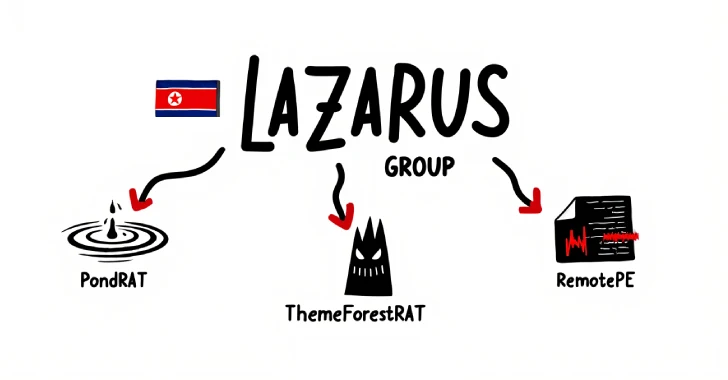
The North Korea-linked threat actor known as the Lazarus Group has been attributed to a social engineering campaign that distributes three different pieces of cross-platform malware called PondRAT, ThemeForestRAT, and RemotePE.

The attack, observed by NCC Group’s Fox-IT in 2024, targeted an organization in the decentralized finance (DeFi) sector, ultimately leading to the compromise of an employee’s system.

“From there, the actor performed discovery from inside the network using different RATs in combination with other tools, for example, to harvest credentials or proxy connections,” Yun Zheng Hu and Mick Koomen said. “Afterwards, the actor moved to a stealthier RAT, likely signifying a next stage in the attack.”

The attack chain begins with the threat actor impersonating an existing employee of a trading company on Telegram and using fake websites masquerading as Calendly and Picktime to schedule a meeting with the victim.

Although the exact initial access vector is currently not known, the foothold is leveraged to deploy a loader called PerfhLoader, which then drops PondRAT, a known malware assessed to be a stripped-down variant of POOLRAT (aka SIMPLESEA). The cybersecurity company said there is some evidence to suggest that a then-zero-day exploit in the Chrome browser may have been used in the attack.

Also delivered along with PondRAT are a number of other tools, including a screenshotter, keylogger, Chrome credential and cookie stealer, Mimikatz, FRPC, and proxy programs like MidProxy and Proxy Mini.

“PondRAT is a straightforward RAT that allows an operator to read and write files, start processes, and run shellcode,” Fox-IT said, adding it dates back to at least 2021. “The actor used PondRAT in combination with ThemeForestRAT for roughly three months, to afterwards clean up and install the more sophisticated RAT called RemotePE.”

The PondRAT malware is designed to communicate over HTTP(S) with a hard-coded command-and-control (C2) server to receive further instructions, with ThemeForestRAT launched directly in memory either via PondRAT or a dedicated loader.

ThemeForestRAT, like PondRAT, monitors for new Remote Desktop (RDP) sessions and contacts a C2 server over HTTP(S) to retrieve as many as twenty commands to enumerate files/directories, perform file operations, execute commands, test TCP connection, timestomp file based on another file on disk, get process listing, download a files, inject shellcode, spawn processes, and hibernate for a specific amount of time.

CIS Build Kits

Fox-IT said ThemeForestRAT shares similarities with a malware codenamed RomeoGolf that was put to use by the Lazarus Group in the November 2014 destructive wiper attack against Sony Pictures Entertainment (SPE). It was documented by Novetta as part of a collaborative effort known as Operation Blockbuster.

RemotePE, on the other hand, is retrieved from a C2 server by RemotePELoader, which, in turn, is loaded by DPAPILoader. Written in C++, RemotePE is a more advanced RAT that’s likely reserved for high-value targets.

“PondRAT is a primitive RAT that provides little flexibility, however, as an initial payload it achieves its purpose,” Fox-IT said. “For more complex tasks, the actor uses ThemeForestRAT, which has more functionality and stays under the radar as it is loaded into memory only.”


Source

computer security cyber attacks cyber news cyber security news cyber security news today cyber security updates cyber updates data breach hacker news hacking news how to hack information security network security ransomware malware software vulnerability the hacker news
Share. Facebook Twitter Pinterest LinkedIn Tumblr Email
Previous ArticleResearchers Warn of MystRodX Backdoor Using DNS and ICMP Triggers for Stealthy Control
Next Article The risks of unsupported IoT tech
Team-CWD
  • Website

Related Posts

News

CERT Polska Details Coordinated Cyber Attacks on 30+ Wind and Solar Farms

February 7, 2026
News

Researchers Uncover Chrome Extensions Abusing Affiliate Links and Stealing ChatGPT Access

February 7, 2026
News

China-Linked UAT-8099 Targets IIS Servers in Asia with BadIIS SEO Malware

February 7, 2026
Add A Comment
Leave A Reply Cancel Reply

Latest News

North Korean Hackers Turn JSON Services into Covert Malware Delivery Channels

November 24, 202522 Views

macOS Stealer Campaign Uses “Cracked” App Lures to Bypass Apple Securi

September 7, 202517 Views

North Korean Hackers Exploit Threat Intel Platforms For Phishing

September 7, 20256 Views

U.S. Treasury Sanctions DPRK IT-Worker Scheme, Exposing $600K Crypto Transfers and $1M+ Profits

September 5, 20256 Views

Ukrainian Ransomware Fugitive Added to Europe’s Most Wanted

September 11, 20255 Views
Stay In Touch
  • Facebook
  • YouTube
  • TikTok
  • WhatsApp
  • Twitter
  • Instagram
Most Popular

North Korean Hackers Turn JSON Services into Covert Malware Delivery Channels

November 24, 202522 Views

macOS Stealer Campaign Uses “Cracked” App Lures to Bypass Apple Securi

September 7, 202517 Views

North Korean Hackers Exploit Threat Intel Platforms For Phishing

September 7, 20256 Views
Our Picks

Your information is on the dark web. What happens next?

January 13, 2026

Drowning in spam or scam emails lately? Here’s why

January 27, 2026

How the always-on generation can level up their cybersecurity game

September 11, 2025

Subscribe to Updates

Get the latest news from cyberwiredaily.com

Facebook X (Twitter) Instagram Pinterest
  • Home
  • Contact
  • Privacy Policy
  • Terms of Use
  • California Consumer Privacy Act (CCPA)
© 2026 All rights reserved.

Type above and press Enter to search. Press Esc to cancel.