Close Menu
  • Home
  • News
  • Cyber Security
  • Internet of Things
  • Tips and Advice

Subscribe to Updates

Get the latest creative news from FooBar about art, design and business.

What's Hot

One In Four Employees Use Unapproved AI Tools, Research Finds

October 30, 2025

TP-Link Patches Four Omada Gateway Flaws, Two Allow Remote Code Execution

October 30, 2025

Defense Contractor Boss Pleads Guilty to Selling Zero-Day Exploits to

October 30, 2025
Facebook X (Twitter) Instagram
Thursday, October 30
Facebook X (Twitter) Instagram Pinterest Vimeo
Cyberwire Daily
  • Home
  • News
  • Cyber Security
  • Internet of Things
  • Tips and Advice
Cyberwire Daily
Home»News»Meta Rolls Out New Tools to Protect WhatsApp and Messenger Users from Scams
News

Meta Rolls Out New Tools to Protect WhatsApp and Messenger Users from Scams

Team-CWDBy Team-CWDOctober 30, 2025No Comments3 Mins Read
Share Facebook Twitter Pinterest LinkedIn Tumblr Reddit Telegram Email
Share
Facebook Twitter LinkedIn Pinterest Email


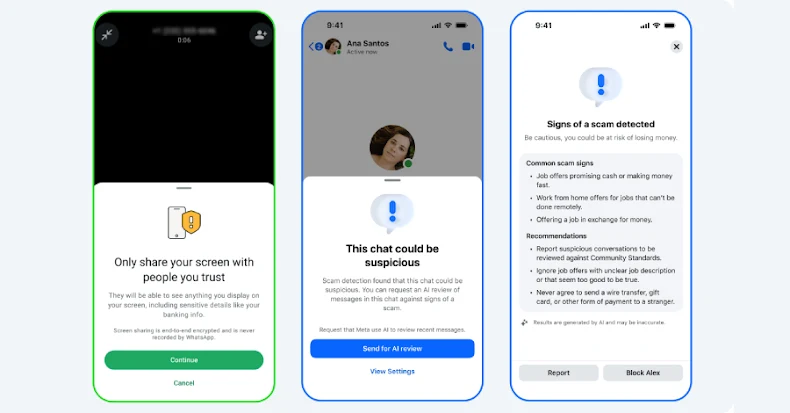
Meta on Tuesday said it’s launching new tools to protect Messenger and WhatsApp users from potential scams.

To that end, the company said it’s introducing new warnings on WhatsApp when users attempt to share their screen with an unknown contact during a video call so as to prevent them from giving away sensitive information like bank details or verification codes.

On Messenger, users can opt to enable a setting called “Scam detection” by navigating to Privacy & safety settings. Once it’s turned on, users are alerted when they receive a potentially suspicious message from an unknown connection that may contain signs of a scam.

“Because detection happens on your device, chats with end-to-end encryption stay secure,” Meta said in a support document. “If you’re notified that a chat may contain signs of a scam, we’ll ask if you’d like to send recent messages you received to AI review. Messages that are shared with AI are no longer end-to-end encrypted.”

If the review finds that it’s indeed a possible scam, users are given more information about common scams, such as job offers in exchange for money, opportunities promising fast cash, and work-from-home offers for jobs that can’t possibly be done remotely. Users are also provided options to block or report the account in question.

As part of its ongoing efforts to combat scams, the social media giant said it took action on over 21,000 Facebook Pages and accounts masquerading as customer support in an attempt to trick people into sharing their personal information.

In addition, Meta said it detected and disrupted close to 8 million accounts on Facebook and Instagram since the start of the year that are associated with criminal scam centers targeting people, including the elderly, across the world through messaging, dating apps, social media, crypto, and other apps. The scam compounds operated out of Myanmar, Laos, Cambodia, the United Arab Emirates, and the Philippines.

These schemes, often called romance baiting (aka pig butchering), are run by cybercrime syndicates based out of Southeast Asia and refer to a type of investment fraud where criminals entice victims into depositing ever-larger sums into bogus platforms with promises of bigger returns.

In many of the cases, the scammers – who are themselves trafficked into the region with lures of high-paying jobs and held against their will – initiate contact with victims through dating apps, social media platforms, or private messaging services like WhatsApp.

Once they establish rapport, the operation moves to the next phase, with the threat actors steering victims toward supposed investment opportunities, often tied to cryptocurrencies, and deceiving them into depositing their funds and ultimately disappearing without a trace.

“Central to the scam is psychological manipulation: perpetrators cultivate emotional bonds, instill confidence, and in some cases even simulate romantic relationships,” Infoblox noted in an analysis published earlier this month. “This drawn-out grooming process lowers victims’ defenses and primes them to believe in promises of extraordinary returns, leading to devastating financial losses.”


Source

computer security cyber attacks cyber news cyber security news cyber security news today cyber security updates cyber updates data breach hacker news hacking news how to hack information security network security ransomware malware software vulnerability the hacker news
Share. Facebook Twitter Pinterest LinkedIn Tumblr Email
Previous ArticleNew Atroposia RAT Surfaces on Dark Web
Next Article Defense Contractor Boss Pleads Guilty to Selling Zero-Day Exploits to
Team-CWD
  • Website

Related Posts

News

One In Four Employees Use Unapproved AI Tools, Research Finds

October 30, 2025
News

TP-Link Patches Four Omada Gateway Flaws, Two Allow Remote Code Execution

October 30, 2025
News

Defense Contractor Boss Pleads Guilty to Selling Zero-Day Exploits to

October 30, 2025
Add A Comment
Leave A Reply Cancel Reply

Latest News

macOS Stealer Campaign Uses “Cracked” App Lures to Bypass Apple Securi

September 7, 202512 Views

North Korean Hackers Exploit Threat Intel Platforms For Phishing

September 7, 20256 Views

U.S. Treasury Sanctions DPRK IT-Worker Scheme, Exposing $600K Crypto Transfers and $1M+ Profits

September 5, 20256 Views

Ukrainian Ransomware Fugitive Added to Europe’s Most Wanted

September 11, 20255 Views

The risks of unsupported IoT tech

September 11, 20255 Views
Stay In Touch
  • Facebook
  • YouTube
  • TikTok
  • WhatsApp
  • Twitter
  • Instagram
Most Popular

macOS Stealer Campaign Uses “Cracked” App Lures to Bypass Apple Securi

September 7, 202512 Views

North Korean Hackers Exploit Threat Intel Platforms For Phishing

September 7, 20256 Views

U.S. Treasury Sanctions DPRK IT-Worker Scheme, Exposing $600K Crypto Transfers and $1M+ Profits

September 5, 20256 Views
Our Picks

When ‘hacking’ your game becomes a security risk

October 17, 2025

AI-powered financial scams swamp social media

September 11, 2025

What is it, and how do I get it off my device?

September 11, 2025

Subscribe to Updates

Get the latest news from cyberwiredaily.com

Facebook X (Twitter) Instagram Pinterest
  • Home
  • Contact
  • Privacy Policy
  • Terms of Use
  • California Consumer Privacy Act (CCPA)
© 2025 All rights reserved.

Type above and press Enter to search. Press Esc to cancel.