Close Menu
  • Home
  • News
  • Cyber Security
  • Internet of Things
  • Tips and Advice

Subscribe to Updates

Get the latest creative news from FooBar about art, design and business.

What's Hot

AISURU/Kimwolf Botnet Launches Record-Setting 31.4 Tbps DDoS Attack

February 14, 2026

Codespaces RCE, AsyncRAT C2, BYOVD Abuse, AI Cloud Intrusions & 15+ Stories

February 14, 2026

The Buyer’s Guide to AI Usage Control

February 13, 2026
Facebook X (Twitter) Instagram
Saturday, February 14
Facebook X (Twitter) Instagram Pinterest Vimeo
Cyberwire Daily
  • Home
  • News
  • Cyber Security
  • Internet of Things
  • Tips and Advice
Cyberwire Daily
Home»News»Munich Security Conference: Cyber Threats Lead G7 Risk Index
News

Munich Security Conference: Cyber Threats Lead G7 Risk Index

Team-CWDBy Team-CWDFebruary 13, 2026No Comments3 Mins Read
Share Facebook Twitter Pinterest LinkedIn Tumblr Reddit Telegram Email
Share
Facebook Twitter LinkedIn Pinterest Email


G7 nations have identified cyber threats as the most significant risk they face, for the second consecutive year,

Asthe Munich Security Conference (MSC)opened in Germany on February 13, the event’s partner consultancy, Kekst CNC, released the latest edition of its annual security risk report, the Munich Security Index (MSI) 2026.

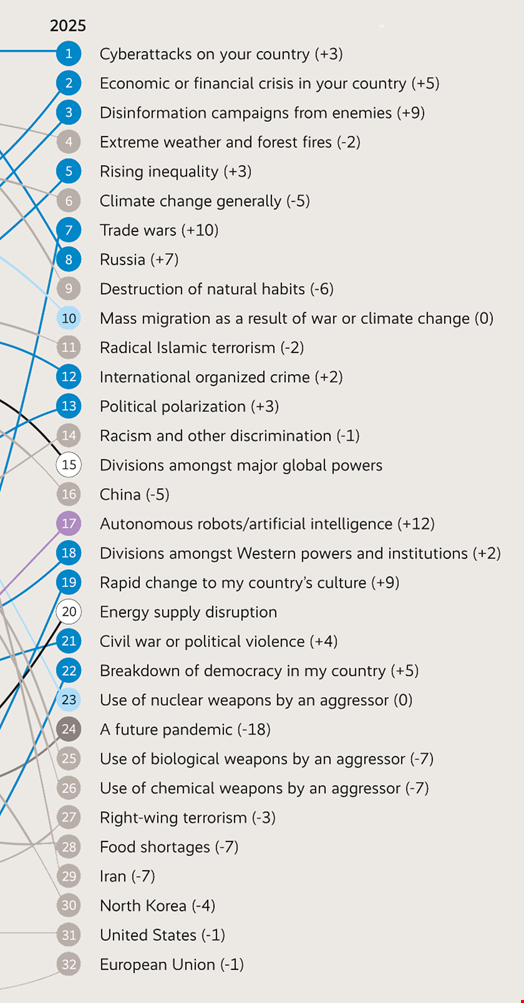
the findings show that G7 countries (Canada, France, Germany, Italy, Japan, the UK and the US) ranked “cyber-attacks on their country” as their top concern in 2025, followed by “economic or financial crisis” and “disinformation campaigns from enemies.”

This marked the second year in a row that cyber threats have held the top spot, rising sharply from fourth place in 2021 and seventh in 2022.

The G7 risk chart, Munich Security Index 2026. Source: Munich Security Conference

Cyber threats are detailed a top priority in Germany, the UK and Japan, where 75%, 74%, and 70% of respondents, respectively, identified cyber-attacks as one of their nation’s most serious risks.

Meanwhile, in the BICS grouping, which refer to BRICS (Brazil, China, India, Russia and South Africa) minus Russia, cyber-attacks have fallen to eighth place in 2025, down from fourth in 2024.

These nations now view “climate change” as their most urgent risk, followed by “extreme weather and forest fires” and “rising inequality.” Disinformation ranks seventh on their list.
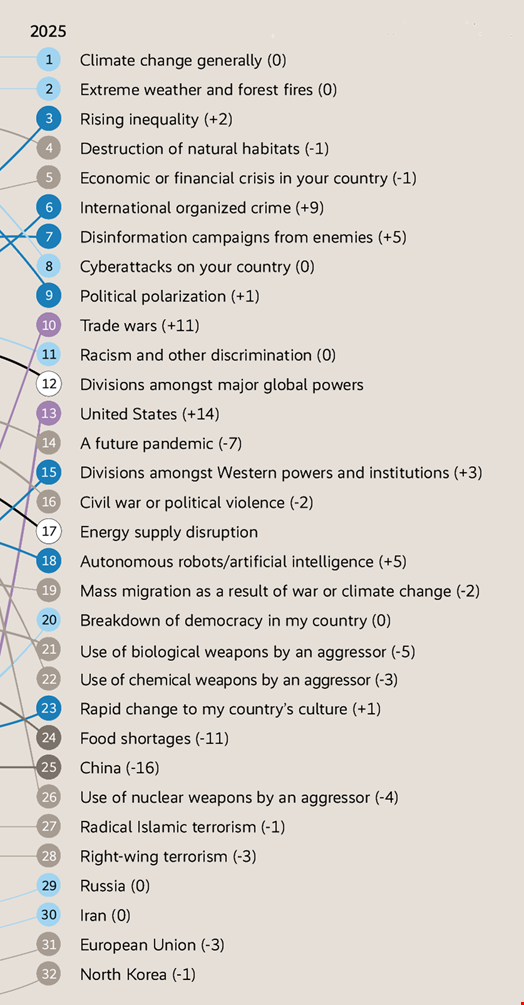
The BICS risk chart, Munich Security Index 2026. Source: Munich Security Conference

Rising Concerns in the UK, US and India

Across most countries, the majority of risks are now seen as less severe compared to last year. However, this trend reverses in the UK, the US, and India, where concerns over threats have grown.

The US, in particular, has seen a sharp rise in perceived risks tied to its economic and political landscape, including fears of food shortages, democratic instability, widening inequality, financial crises, civil unrest or political violence and escalating trade conflicts.

This year’s edition of the MSI was based on representative samples of around 1000 adults from each G7 and BICS nation, with 11,099 people surveyed in total. Polling was conducted by Kekst CNC and fieldwork partners between November 5 and 25, 2025, using industry-leading online panels.

The seriousness of each identified risk was measured based on five dimensions (severity, imminence, preparedness, trajectory and an overall criteria), each captured by a separate question. Respondents were selected according to stratified quotas for gender, age, residency, formal education and income to ensure representativeness. The final data was then weighted

to exactly match the quotas. The margin of error is 3.1 percent.

“Polling in autocracies is always challenging, as respondents may not feel that they can freely express their views. The results from China should therefore be interpreted with caution,” said the MSI authors.

Read now: Nation-State Hackers Embrace Gemini AI for Malicious Campaigns, Google Finds


Source

Share. Facebook Twitter Pinterest LinkedIn Tumblr Email
Previous ArticleCritical n8n Flaw CVE-2026-25049 Enables System Command Execution via Malicious Workflows
Next Article Infy Hackers Resume Operations with New C2 Servers After Iran Internet Blackout Ends
Team-CWD
  • Website

Related Posts

News

AISURU/Kimwolf Botnet Launches Record-Setting 31.4 Tbps DDoS Attack

February 14, 2026
News

Codespaces RCE, AsyncRAT C2, BYOVD Abuse, AI Cloud Intrusions & 15+ Stories

February 14, 2026
News

The Buyer’s Guide to AI Usage Control

February 13, 2026
Add A Comment
Leave A Reply Cancel Reply

Latest News

North Korean Hackers Turn JSON Services into Covert Malware Delivery Channels

November 24, 202522 Views

macOS Stealer Campaign Uses “Cracked” App Lures to Bypass Apple Securi

September 7, 202517 Views

North Korean Hackers Exploit Threat Intel Platforms For Phishing

September 7, 20256 Views

U.S. Treasury Sanctions DPRK IT-Worker Scheme, Exposing $600K Crypto Transfers and $1M+ Profits

September 5, 20256 Views

Ukrainian Ransomware Fugitive Added to Europe’s Most Wanted

September 11, 20255 Views
Stay In Touch
  • Facebook
  • YouTube
  • TikTok
  • WhatsApp
  • Twitter
  • Instagram
Most Popular

North Korean Hackers Turn JSON Services into Covert Malware Delivery Channels

November 24, 202522 Views

macOS Stealer Campaign Uses “Cracked” App Lures to Bypass Apple Securi

September 7, 202517 Views

North Korean Hackers Exploit Threat Intel Platforms For Phishing

September 7, 20256 Views
Our Picks

Top IRS scams to look out for in 2026

February 10, 2026

Can password managers get hacked? Here’s what to know

November 14, 2025

What it is and how to protect yourself

January 8, 2026

Subscribe to Updates

Get the latest news from cyberwiredaily.com

Facebook X (Twitter) Instagram Pinterest
  • Home
  • Contact
  • Privacy Policy
  • Terms of Use
  • California Consumer Privacy Act (CCPA)
© 2026 All rights reserved.

Type above and press Enter to search. Press Esc to cancel.