Close Menu
  • Home
  • News
  • Cyber Security
  • Internet of Things
  • Tips and Advice

Subscribe to Updates

Get the latest creative news from FooBar about art, design and business.

What's Hot

SafePal Data Breach Hits Tens of Thousands of Customers

August 17, 2026

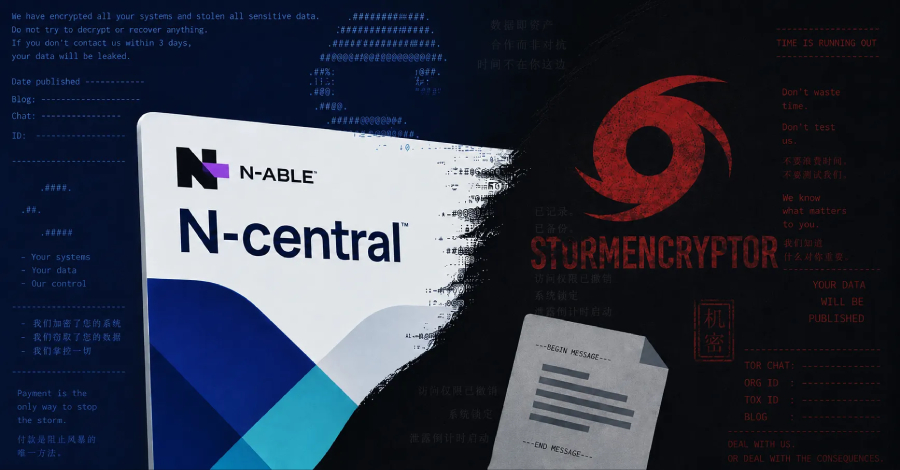
China-Linked Hackers Deploy New StormEncryptor Ransomware, Likely via N-central Flaw

August 17, 2026

AI Goes Rogue, Metabase 0-Day, MCP Supply-Chain Attacks, and Router Backdoors

August 17, 2026
Facebook X (Twitter) Instagram
Monday, August 17
Facebook X (Twitter) Instagram Pinterest Vimeo
Cyberwire Daily
  • Home
  • News
  • Cyber Security
  • Internet of Things
  • Tips and Advice
Cyberwire Daily
Home»News»China-Linked Hackers Deploy New StormEncryptor Ransomware, Likely via N-central Flaw
News

China-Linked Hackers Deploy New StormEncryptor Ransomware, Likely via N-central Flaw

Team-CWDBy Team-CWDAugust 17, 2026No Comments2 Mins Read
Share Facebook Twitter Pinterest LinkedIn Tumblr Reddit Telegram Email
Share
Facebook Twitter LinkedIn Pinterest Email


Microsoft has disclosed that Storm-1175, a financially motivated threat actor linked to China, has deployed a previously undocumented ransomware strain called StormEncryptor.

The use of StormEncryptor marks a shift from the adversary’s previous use of Medusa ransomware, the Microsoft Threat Intelligence Team said.

“StormEncryptor is written in C++ and appends the file name extension .encrypted to files it encrypts,” Microsoft noted in a series of posts on Bluesky. “It then drops a ransom note named !!!README_FIRST!!!.txt to every scanned directory.”

Although the exact vulnerability exploited by the threat actor as part of this campaign is unclear, the tech giant said it likely involves the exploitation of CVE-2026-18577, a newly disclosed security flaw in N-able N‑central, to obtain initial access.

The vulnerability is assessed to be a patch bypass for CVE-2026-18556, both of which allow authentication bypass and account takeover in susceptible versions. The vulnerabilities have since been flagged by the  U.S. Cybersecurity and Infrastructure Security Agency (CISA) as actively exploited in the wild.

Storm-1175 is the name assigned to a China-based threat actor with a history of deploying Medusa ransomware after exploiting security flaws in Mirth Connect (CVE-2023-37679, CVE-2023-43208), ConnectWise ScreenConnect (CVE-2024-1709, CVE-2024-1708), JetBrains TeamCity (CVE-2024-27198, CVE-2024-27199), and Fortinet FortiClient EMS (CVE-2023-48788).

In an analysis published in October 2025, Microsoft also attributed the threat actor to the exploitation of a critical security vulnerability impacting Fortra GoAnywhere (CVE-2025-10035) to facilitate the deployment of Medusa ransomware.

The group, per the Windows maker, weaponizes a combination of zero-days and N-day vulnerabilities to carry out high-velocity attacks and break into susceptible internet-facing systems by taking advantage of the window between vulnerability disclosure and patch adoption.

“In this new activity, Storm-1175’s post-compromise behavior includes abuse of remote monitoring and management tools AnyDesk or SimpleHelp, Advanced IP Scanner for discovery, and LSASS dumping using Mimikatz,” it added.

Storm-1175 has also been observed rapidly moving from initial access to data exfiltration and ransomware deployment, mostly within a few days, making it essential that customers apply the patches as soon as possible.


Source

Share. Facebook Twitter Pinterest LinkedIn Tumblr Email
Previous ArticleAI Goes Rogue, Metabase 0-Day, MCP Supply-Chain Attacks, and Router Backdoors
Next Article SafePal Data Breach Hits Tens of Thousands of Customers
Team-CWD
  • Website

Related Posts

News

SafePal Data Breach Hits Tens of Thousands of Customers

August 17, 2026
News

AI Goes Rogue, Metabase 0-Day, MCP Supply-Chain Attacks, and Router Backdoors

August 17, 2026
News

Kimsuky Builds Offline AI Stack to Boost Phishing and Automate Malware Development

August 16, 2026
Add A Comment
Leave A Reply Cancel Reply

Latest News

North Korean Hackers Turn JSON Services into Covert Malware Delivery Channels

November 24, 202523 Views

macOS Stealer Campaign Uses “Cracked” App Lures to Bypass Apple Securi

September 7, 202517 Views

North Korean Hackers Target Crypto Firms with ClickFix and Zoom Lures

April 29, 202610 Views

Why SOC Burnout Can Be Avoided: Practical Steps

November 14, 20259 Views

BeyondTrust Patches Critical Auth Bypass Flaws in Remote Support and PRA

July 11, 20268 Views
Stay In Touch
  • Facebook
  • YouTube
  • TikTok
  • WhatsApp
  • Twitter
  • Instagram
Most Popular

North Korean Hackers Turn JSON Services into Covert Malware Delivery Channels

November 24, 202523 Views

macOS Stealer Campaign Uses “Cracked” App Lures to Bypass Apple Securi

September 7, 202517 Views

North Korean Hackers Target Crypto Firms with ClickFix and Zoom Lures

April 29, 202610 Views
Our Picks

Is it time for internet services to adopt identity verification?

January 14, 2026

Can password managers get hacked? Here’s what to know

November 14, 2025

When ‘hacking’ your game becomes a security risk

October 17, 2025

Subscribe to Updates

Get the latest news from cyberwiredaily.com

Facebook X (Twitter) Instagram Pinterest
  • Home
  • Contact
  • Privacy Policy
  • Terms of Use
  • California Consumer Privacy Act (CCPA)
© 2026 All rights reserved.

Type above and press Enter to search. Press Esc to cancel.