Close Menu
  • Home
  • News
  • Cyber Security
  • Internet of Things
  • Tips and Advice

Subscribe to Updates

Get the latest creative news from FooBar about art, design and business.

What's Hot

Badges, Bytes and Blackmail

February 7, 2026

Ex-Google Engineer Convicted for Stealing AI Secrets for China Startup

February 7, 2026

Substack Confirms Data Breach, “Limited User Data” Compromised

February 6, 2026
Facebook X (Twitter) Instagram
Saturday, February 7
Facebook X (Twitter) Instagram Pinterest Vimeo
Cyberwire Daily
  • Home
  • News
  • Cyber Security
  • Internet of Things
  • Tips and Advice
Cyberwire Daily
Home»News»CISA Flags Meteobridge CVE-2025-4008 Flaw as Actively Exploited in the Wild
News

CISA Flags Meteobridge CVE-2025-4008 Flaw as Actively Exploited in the Wild

Team-CWDBy Team-CWDOctober 12, 2025No Comments3 Mins Read
Share Facebook Twitter Pinterest LinkedIn Tumblr Reddit Telegram Email
Share
Facebook Twitter LinkedIn Pinterest Email


The U.S. Cybersecurity and Infrastructure Security Agency (CISA) on Thursday added a high-severity security flaw impacting Smartbedded Meteobridge to its Known Exploited Vulnerabilities (KEV) catalog, citing evidence of active exploitation.

The vulnerability, CVE-2025-4008 (CVSS score: 8.7), is a case of command injection in the Meteobridge web interface that could result in code execution.

“Smartbedded Meteobridge contains a command injection vulnerability that could allow remote unauthenticated attackers to gain arbitrary command execution with elevated privileges (root) on affected devices,” CISA Said.

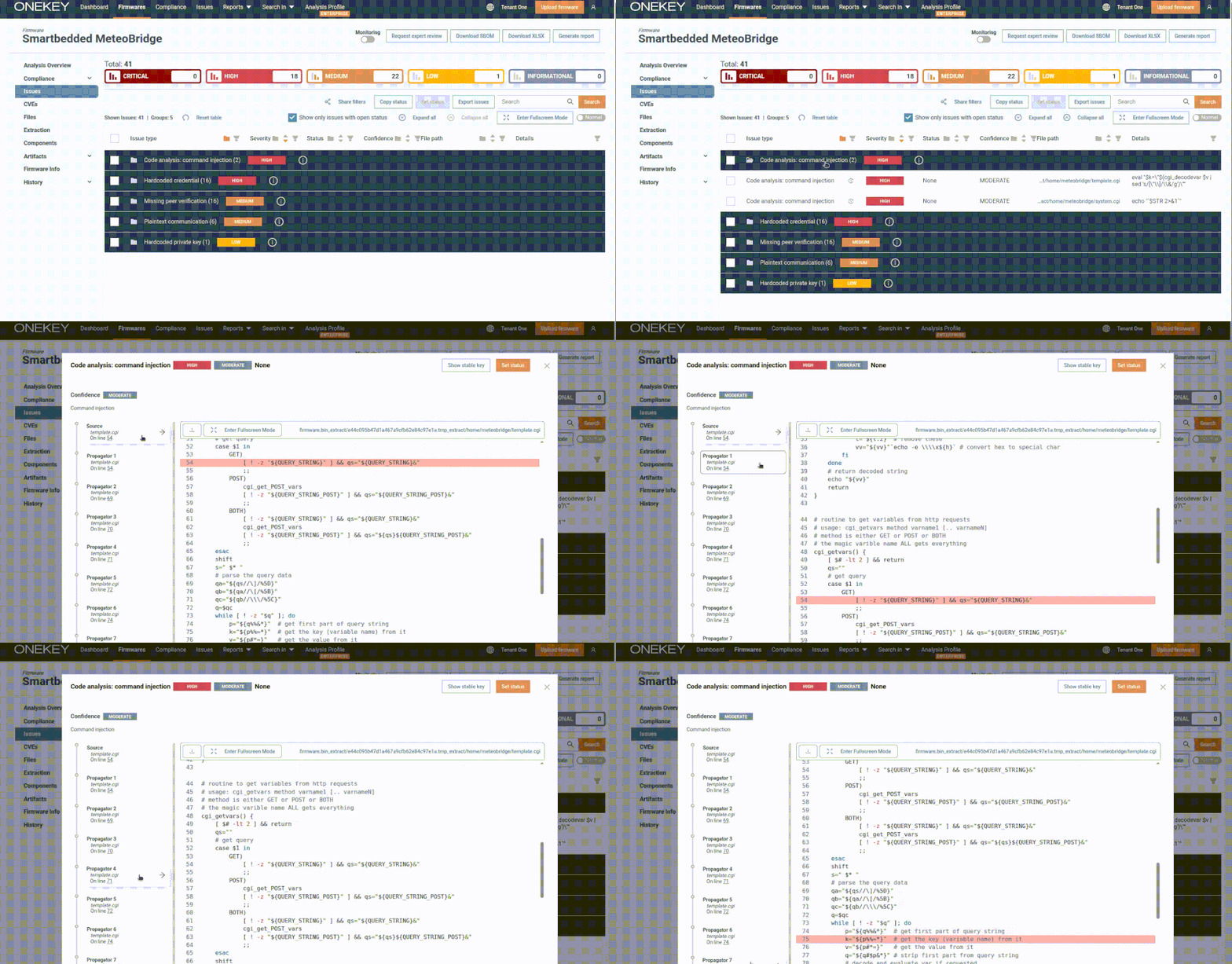
According to ONEKEY, which discovered and reported the issue in late February 2025, the Meteobridge web interface lets an administrator manage their weather station data collection and control the system through a web application written in CGI shell scripts and C.

Specifically, the web interface exposes a “template.cgi” script through “/cgi-bin/template.cgi,” which is vulnerable to command injection stemming from the insecure use of eval calls, allowing an attacker to supply specially crafted requests to execute arbitrary code –

curl -i -u meteobridge: meteobridge 
'https://192.168.88.138/cgi-bin/template.cgi?$(id>/tmp/a)=whatever'

Furthermore, ONEKEY said the vulnerability can be exploited by unauthenticated attackers due to the fact that the CGI script is hosted in a public directory without requiring any authentication.

“Remote exploitation through a malicious webpage is also possible since it’s a GET request without any kind of custom header or token parameter,” security researcher Quentin Kaiser noted back in May. “Just send a link to your victim and create img tags with the src set to ‘https://subnet.a/public/template.cgi?templatefile=$(command).'”

There are currently no public reports referencing how CVE-2025-4008 is being exploited in the wild. The vulnerability was addressed in Meteobridge version 6.2, released on May 13, 2025.

Also added by CISA to the KEV catalog are four other flaws –

  • CVE-2025-21043 (CVSS score: 8.8) – Samsung mobile devices contain an out-of-bounds write vulnerability in libimagecodec.quram.so that could allow remote attackers to execute arbitrary code.
  • CVE-2017-1000353 (CVSS score: 9.8) – Jenkins contains a deserialization of untrusted data vulnerability that could allow unauthenticated remote code execution, bypassing denylist-based protection mechanisms.
  • CVE-2015-7755 (CVSS score: 9.8) – Juniper ScreenOS contains an improper authentication vulnerability that could allow unauthorized remote administrative access to the device.
  • CVE-2014-6278, aka Shellshock (CVSS score: 8.8) – GNU Bash contains an OS command injection vulnerability that could allow remote attackers to execute arbitrary commands via a crafted environment.

In light of active exploitation, Federal Civilian Executive Branch (FCEB) agencies are required to apply the necessary updates by October 23, 2025, for optimal protection.


Source

computer security cyber attacks cyber news cyber security news cyber security news today cyber security updates cyber updates data breach hacker news hacking news how to hack information security network security ransomware malware software vulnerability the hacker news
Share. Facebook Twitter Pinterest LinkedIn Tumblr Email
Previous ArticleConfucius Hackers Hit Pakistan With New WooperStealer and Anondoor Malware
Next Article New “Cavalry Werewolf” Attack Hits Russian Agencies with FoalShell and StallionRAT
Team-CWD
  • Website

Related Posts

News

Badges, Bytes and Blackmail

February 7, 2026
News

Ex-Google Engineer Convicted for Stealing AI Secrets for China Startup

February 7, 2026
News

Substack Confirms Data Breach, “Limited User Data” Compromised

February 6, 2026
Add A Comment
Leave A Reply Cancel Reply

Latest News

North Korean Hackers Turn JSON Services into Covert Malware Delivery Channels

November 24, 202522 Views

macOS Stealer Campaign Uses “Cracked” App Lures to Bypass Apple Securi

September 7, 202517 Views

North Korean Hackers Exploit Threat Intel Platforms For Phishing

September 7, 20256 Views

U.S. Treasury Sanctions DPRK IT-Worker Scheme, Exposing $600K Crypto Transfers and $1M+ Profits

September 5, 20256 Views

Ukrainian Ransomware Fugitive Added to Europe’s Most Wanted

September 11, 20255 Views
Stay In Touch
  • Facebook
  • YouTube
  • TikTok
  • WhatsApp
  • Twitter
  • Instagram
Most Popular

North Korean Hackers Turn JSON Services into Covert Malware Delivery Channels

November 24, 202522 Views

macOS Stealer Campaign Uses “Cracked” App Lures to Bypass Apple Securi

September 7, 202517 Views

North Korean Hackers Exploit Threat Intel Platforms For Phishing

September 7, 20256 Views
Our Picks

What if your romantic AI chatbot can’t keep a secret?

November 18, 2025

When ‘hacking’ your game becomes a security risk

October 17, 2025

The hidden risks of browser extensions – and how to avoid them

September 13, 2025

Subscribe to Updates

Get the latest news from cyberwiredaily.com

Facebook X (Twitter) Instagram Pinterest
  • Home
  • Contact
  • Privacy Policy
  • Terms of Use
  • California Consumer Privacy Act (CCPA)
© 2026 All rights reserved.

Type above and press Enter to search. Press Esc to cancel.