Close Menu
  • Home
  • News
  • Cyber Security
  • Internet of Things
  • Tips and Advice

Subscribe to Updates

Get the latest creative news from FooBar about art, design and business.

What's Hot

The Security Coverage Gap is a Math Problem

June 26, 2026

China-Linked Hackers Strike Asian CNI with New Backdoor

June 26, 2026

How to Find Hidden Access Risks Inside Your Network

June 26, 2026
Facebook X (Twitter) Instagram
Friday, June 26
Facebook X (Twitter) Instagram Pinterest Vimeo
Cyberwire Daily
  • Home
  • News
  • Cyber Security
  • Internet of Things
  • Tips and Advice
Cyberwire Daily
Home»News»Critical React Native CLI Flaw Exposed Millions of Developers to Remote Attacks
News

Critical React Native CLI Flaw Exposed Millions of Developers to Remote Attacks

Team-CWDBy Team-CWDNovember 14, 2025No Comments2 Mins Read
Share Facebook Twitter Pinterest LinkedIn Tumblr Reddit Telegram Email
Share
Facebook Twitter LinkedIn Pinterest Email


Details have emerged about a now-patched critical security flaw in the popular “@react-native-community/cli” npm package that could be potentially exploited to run malicious operating system (OS) commands under certain conditions.

“The vulnerability allows remote unauthenticated attackers to easily trigger arbitrary OS command execution on the machine running react-native-community/cli’s development server, posing a significant risk to developers,” JFrog Senior Security Researcher Or Peles said in a report shared with The Hacker News.

The vulnerability, tracked as CVE-2025-11953, carries a CVSS score of 9.8 out of a maximum of 10.0, indicating critical severity. It also affects the “@react-native-community/cli-server-api” package versions 4.8.0 through 20.0.0-alpha.2, and has been patched in version 20.0.0 released early last month.

The command-line tools package, which is maintained by Meta, enables developers to build React Native mobile applications. It receives approximately 1.5 million to 2 million downloads per week.

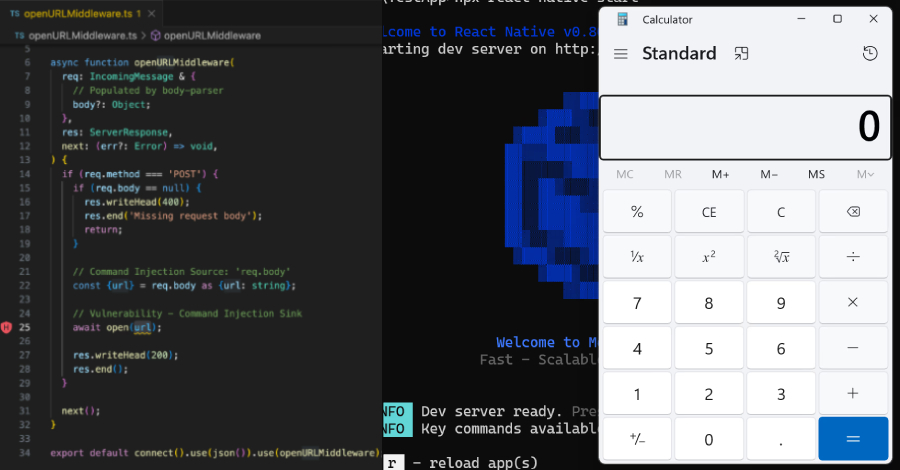
According to the software supply chain security firm, the vulnerability arises from the fact that the Metro development server used by React Native to build JavaScript code and assets binds to external interfaces by default (instead of localhost) and exposes an “/open-url” endpoint that is susceptible to OS command injection.

“The server’s ‘/open-url’ endpoint handles a POST request that includes a user-input value that is passed to the unsafe open() function provided by the open NPM package, which will cause OS command execution,” Peles said.

As a result, an unauthenticated network attacker could weaponize the flaw to send a specially crafted POST request to the server and run arbitrary commands. On Windows, the attackers can also execute arbitrary shell commands with fully controlled arguments, while on Linux and macOS, it can be abused to execute arbitrary binaries with limited parameter control.

While the issue has since been addressed, developers who use React Native with a framework that doesn’t rely on Metro as the development server are not impacted.

“This zero day vulnerability is particularly dangerous due to its ease of exploitation, lack of authentication requirements and broad attack surface,” Peles said. “It also exposes the critical risks hidden in third-party code.”

“For developer and security teams, this underscores the need for automated, comprehensive security scanning across the software supply chain to ensure easily exploitable flaws are remediated before they impact your organization.”


Source

computer security cyber attacks cyber news cyber security news cyber security news today cyber security updates cyber updates data breach hacker news hacking news how to hack information security network security ransomware malware software vulnerability the hacker news
Share. Facebook Twitter Pinterest LinkedIn Tumblr Email
Previous ArticleOperation Endgame 3.0 Dismantles Three Major Malware Networks
Next Article Improve Collaboration to Hit Back At Rising Fraud, Says techUK
Team-CWD
  • Website

Related Posts

News

China-Linked Hackers Strike Asian CNI with New Backdoor

June 26, 2026
News

How to Find Hidden Access Risks Inside Your Network

June 26, 2026
News

CMC Releases Analysis and Guidance for Education Sector After Canvas D

June 26, 2026
Add A Comment
Leave A Reply Cancel Reply

Latest News

North Korean Hackers Turn JSON Services into Covert Malware Delivery Channels

November 24, 202522 Views

macOS Stealer Campaign Uses “Cracked” App Lures to Bypass Apple Securi

September 7, 202517 Views

North Korean Hackers Target Crypto Firms with ClickFix and Zoom Lures

April 29, 202610 Views

Why SOC Burnout Can Be Avoided: Practical Steps

November 14, 20259 Views

Cyber M&A Roundup: Cyber Giants Strengthen AI Security Offerings

December 1, 20258 Views
Stay In Touch
  • Facebook
  • YouTube
  • TikTok
  • WhatsApp
  • Twitter
  • Instagram
Most Popular

North Korean Hackers Turn JSON Services into Covert Malware Delivery Channels

November 24, 202522 Views

macOS Stealer Campaign Uses “Cracked” App Lures to Bypass Apple Securi

September 7, 202517 Views

North Korean Hackers Target Crypto Firms with ClickFix and Zoom Lures

April 29, 202610 Views
Our Picks

Mobile app permissions (still) matter more than you may think

February 27, 2026

‘What happens online stays online’ and other cyberbullying myths, debunked

September 11, 2025

Children and chatbots: What parents should know

January 23, 2026

Subscribe to Updates

Get the latest news from cyberwiredaily.com

Facebook X (Twitter) Instagram Pinterest
  • Home
  • Contact
  • Privacy Policy
  • Terms of Use
  • California Consumer Privacy Act (CCPA)
© 2026 All rights reserved.

Type above and press Enter to search. Press Esc to cancel.