Close Menu
  • Home
  • News
  • Cyber Security
  • Internet of Things
  • Tips and Advice

Subscribe to Updates

Get the latest creative news from FooBar about art, design and business.

What's Hot

Iran-Linked MuddyWater Poses as Ransomware Gang to Mask Espionage

June 25, 2026

CISA Warns of Actively Exploited Joomla JCE Flaw Allowing PHP Code Execution

June 24, 2026

Researchers Trick AI Browsers Into Leaking Credentials

June 24, 2026
Facebook X (Twitter) Instagram
Thursday, June 25
Facebook X (Twitter) Instagram Pinterest Vimeo
Cyberwire Daily
  • Home
  • News
  • Cyber Security
  • Internet of Things
  • Tips and Advice
Cyberwire Daily
Home»News»MetInfo CMS CVE-2026-29014 Exploited for Remote Code Execution Attacks
News

MetInfo CMS CVE-2026-29014 Exploited for Remote Code Execution Attacks

Team-CWDBy Team-CWDMay 13, 2026No Comments2 Mins Read
Share Facebook Twitter Pinterest LinkedIn Tumblr Reddit Telegram Email
Share
Facebook Twitter LinkedIn Pinterest Email


Threat actors are actively exploiting a critical security flaw impacting an open-source content management system (CMS) known as MetInfo, according to new findings from VulnCheck.

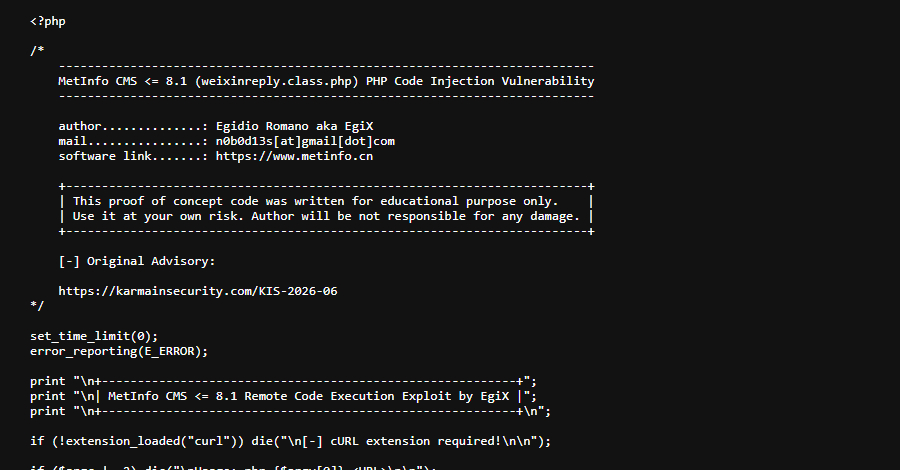
The vulnerability in question is CVE-2026-29014 (CVSS score: 9.8), a code injection flaw that could result in arbitrary code execution.

“MetInfo CMS versions 7.9, 8.0, and 8.1 contain an unauthenticated PHP code injection vulnerability that allows remote attackers to execute arbitrary code by sending crafted requests with malicious PHP code,” the NIST National Vulnerability Database (NVD) states.

“Attackers can exploit insufficient input neutralization in the execution path to achieve remote code execution and gain full control over the affected server.”

Per security researcher Egidio Romano, who discovered the vulnerability, the problem is rooted in the “/app/system/weixin/include/class/weixinreply.class.php” script, and stems from a lack of adequate sanitization of user-supplied input when issuing Weixin (aka WeChat) API requests.

As a result, remote, unauthenticated attackers could exploit this loophole to inject and execute arbitrary PHP code. One key prerequisite for successful exploitation when MetInfo is running on non-Windows servers is that the “/cache/weixin/” directory has to exist beforehand.The directory is created when installing and configuring the official WeChat plugin. 

Patches for CVE-2026-29014 were released by MetInfo on April 7, 2026. The vulnerability has since come under exploitation as of April 25, with a “small number of exploits” deployed against susceptible honeypots located in the U.S. and Singapore.

Although these efforts were initially sparse and associated with automated probing, the activity witnessed a surge on May 1, 2026, focusing on China and Hong Kong IP addresses, Caitlin Condon, vice president of security research at VulnCheck, said. As many as 2,000 instances of MetInfo CMS are accessible online, most of which are in China.


Source

Share. Facebook Twitter Pinterest LinkedIn Tumblr Email
Previous ArticleGlobal Cyber Agencies Issue New SBOMs for AI Guidance
Next Article Avada Builder Flaws Expose One Million WordPress Sites
Team-CWD
  • Website

Related Posts

News

CISA Warns of Actively Exploited Joomla JCE Flaw Allowing PHP Code Execution

June 24, 2026
News

Researchers Trick AI Browsers Into Leaking Credentials

June 24, 2026
News

Google Vertex AI SDK Flaw Let Attackers Hijack Model Uploads via Bucket Squatting

June 24, 2026
Add A Comment
Leave A Reply Cancel Reply

Latest News

North Korean Hackers Turn JSON Services into Covert Malware Delivery Channels

November 24, 202522 Views

macOS Stealer Campaign Uses “Cracked” App Lures to Bypass Apple Securi

September 7, 202517 Views

North Korean Hackers Target Crypto Firms with ClickFix and Zoom Lures

April 29, 202610 Views

Why SOC Burnout Can Be Avoided: Practical Steps

November 14, 20259 Views

Cyber M&A Roundup: Cyber Giants Strengthen AI Security Offerings

December 1, 20258 Views
Stay In Touch
  • Facebook
  • YouTube
  • TikTok
  • WhatsApp
  • Twitter
  • Instagram
Most Popular

North Korean Hackers Turn JSON Services into Covert Malware Delivery Channels

November 24, 202522 Views

macOS Stealer Campaign Uses “Cracked” App Lures to Bypass Apple Securi

September 7, 202517 Views

North Korean Hackers Target Crypto Firms with ClickFix and Zoom Lures

April 29, 202610 Views
Our Picks

How it preys on personal data – and how to stay safe

October 23, 2025

A phishing attack that doesn’t steal your password

June 15, 2026

What is it, and how do I get it off my device?

September 11, 2025

Subscribe to Updates

Get the latest news from cyberwiredaily.com

Facebook X (Twitter) Instagram Pinterest
  • Home
  • Contact
  • Privacy Policy
  • Terms of Use
  • California Consumer Privacy Act (CCPA)
© 2026 All rights reserved.

Type above and press Enter to search. Press Esc to cancel.