Close Menu
  • Home
  • News
  • Cyber Security
  • Internet of Things
  • Tips and Advice

Subscribe to Updates

Get the latest creative news from FooBar about art, design and business.

What's Hot

Cybercriminals Bypass AI Safety Controls by Splitting Malicious Tasks

August 4, 2026

Public PoC Released for Exploited Check Point SmartConsole Authentication Bypass

August 4, 2026

AI Accounts for Over Half of Cybercrime in Africa, Says Interpol

August 4, 2026
Facebook X (Twitter) Instagram
Tuesday, August 4
Facebook X (Twitter) Instagram Pinterest Vimeo
Cyberwire Daily
  • Home
  • News
  • Cyber Security
  • Internet of Things
  • Tips and Advice
Cyberwire Daily
Home»News»Public PoC Released for Exploited Check Point SmartConsole Authentication Bypass
News

Public PoC Released for Exploited Check Point SmartConsole Authentication Bypass

Team-CWDBy Team-CWDAugust 4, 2026No Comments3 Mins Read
Share Facebook Twitter Pinterest LinkedIn Tumblr Reddit Telegram Email
Share
Facebook Twitter LinkedIn Pinterest Email


Cybersecurity researchers have shared additional technical details about a recently patched critical security flaw impacting Check Point Security Management Server and Multi-Domain Security Management Server (MDS) that has come under active exploitation in the wild.

The vulnerability, tracked as CVE-2026-16232 (CVSS score: 9.3), is an authentication bypass in the SmartConsole login process that allows an unauthenticated remote attacker to obtain an application login token and use it to authenticate with full administrative privileges.

“By leveraging CVE-2026-16232, an unauthenticated attacker can obtain an application login token, use this token to log in through SmartConsole with full administrator privileges, and modify the security policy or security configuration,” Rapid7 said.

Successful exploitation requires an attacker to have network access to the Management Server and a configuration that does not restrict Trusted Clients. Check Point has disclosed that it’s aware of a handful of customers being targeted by this flaw as a zero-day.

Rapid7 analysis of the vulnerability has uncovered that the root cause is a “broken trust boundary” in the application authentication path that permits the threat actor to log in to a vulnerable appliance via SmartConsole with full admin privileges.

Specifically, a vulnerable server has been found to accept an attacker-supplied Secure Internal Communication (SIC) distinguished name (DN) as the identity of a remote application as opposed to binding that identity to the authenticated remote peer certificate DN returned by a function named “getCertificateDnName().”

As a result, an attacker can read the management server’s own SIC DN during the unauthenticated bootstrap communication and authenticate as a remote application by replaying that management server’s DN, obtaining an application login token, and then minting a new SmartConsole single sign-on (SSO) ticket via the forged application session.

The patch introduced by Check Point ensures that remote clients use the authenticated remote peer certificate DN, causing any mismatch between the supplied DN and that authenticated identity to be rejected. It also adds a new empty identity check that prevents a remote application login when there is no authenticated SIC identity.

“To make the supplied server DN survive the patched checks, the attacker would need an authenticated client certificate whose subject DN already matches that server DN, which removes the unauthenticated bypass,” Rapid7’s Stephen Fewer said.

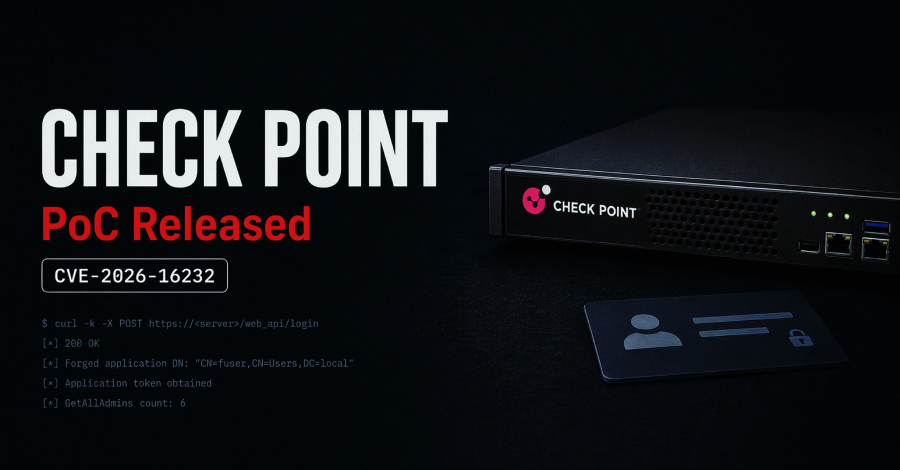
Rapid7 has released a proof-of-concept (PoC) Python script that can be used to successfully validate whether a target is either vulnerable or patched against the flaw.

Customers are advised to apply the Jumbo Hotfixes released by Check Point on July 22, 2026, to remediate the flaw as soon as possible.


Source

Share. Facebook Twitter Pinterest LinkedIn Tumblr Email
Previous ArticleAI Accounts for Over Half of Cybercrime in Africa, Says Interpol
Next Article Cybercriminals Bypass AI Safety Controls by Splitting Malicious Tasks
Team-CWD
  • Website

Related Posts

News

Cybercriminals Bypass AI Safety Controls by Splitting Malicious Tasks

August 4, 2026
News

AI Accounts for Over Half of Cybercrime in Africa, Says Interpol

August 4, 2026
News

Flying Eagle Android RAT Traces Found on 170 Servers as Source Code Circulates

August 4, 2026
Add A Comment
Leave A Reply Cancel Reply

Latest News

North Korean Hackers Turn JSON Services into Covert Malware Delivery Channels

November 24, 202523 Views

macOS Stealer Campaign Uses “Cracked” App Lures to Bypass Apple Securi

September 7, 202517 Views

North Korean Hackers Target Crypto Firms with ClickFix and Zoom Lures

April 29, 202610 Views

Why SOC Burnout Can Be Avoided: Practical Steps

November 14, 20259 Views

BeyondTrust Patches Critical Auth Bypass Flaws in Remote Support and PRA

July 11, 20268 Views
Stay In Touch
  • Facebook
  • YouTube
  • TikTok
  • WhatsApp
  • Twitter
  • Instagram
Most Popular

North Korean Hackers Turn JSON Services into Covert Malware Delivery Channels

November 24, 202523 Views

macOS Stealer Campaign Uses “Cracked” App Lures to Bypass Apple Securi

September 7, 202517 Views

North Korean Hackers Target Crypto Firms with ClickFix and Zoom Lures

April 29, 202610 Views
Our Picks

How the always-on generation can level up their cybersecurity game

September 11, 2025

Fixing trivial passwords is as easy as 123456

May 7, 2026

A stealthy RAT burrowing deep into Android devices

May 26, 2026

Subscribe to Updates

Get the latest news from cyberwiredaily.com

Facebook X (Twitter) Instagram Pinterest
  • Home
  • Contact
  • Privacy Policy
  • Terms of Use
  • California Consumer Privacy Act (CCPA)
© 2026 All rights reserved.

Type above and press Enter to search. Press Esc to cancel.