


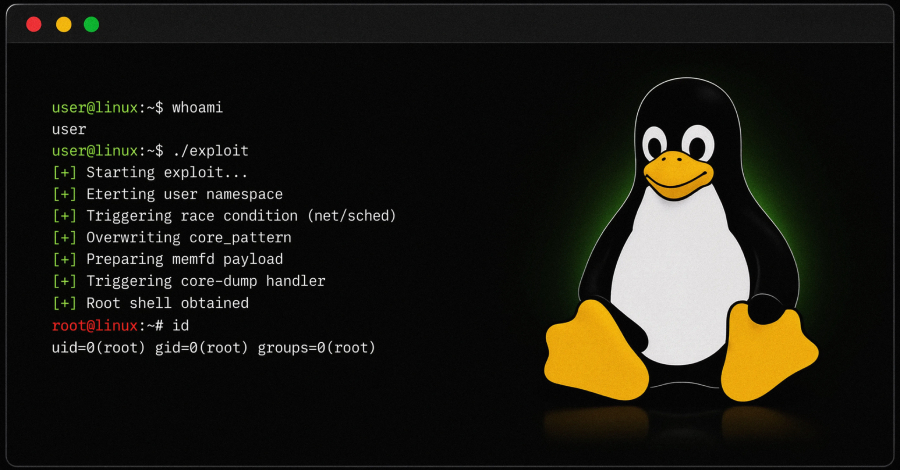
STAR Labs has published a Linux kernel exploit that turns an ordinary local user into root on the CentOS Stream 9 build it targeted. The flaw, tracked as CVE-2026-53264 (CVSS score: 7.8), is a use-after-free race in the kernel’s network traffic-control subsystem.
Researcher Lee Jia Jie said artificial intelligence (AI) helped him find the bug and speed up exploit development. This is local privilege escalation, not remote code execution, so an attacker needs a foothold on the machine before any of it applies.
The demonstrated exploit also requires unprivileged user namespaces, the CONFIG_NET_ACT_GACT and CONFIG_NET_CLS_FLOWER kernel options, and a kernel-specific return-oriented programming (ROP) chain containing hardcoded offsets. Those conditions narrow the immediate exposure, but full exploit source code is now public.
The upstream fix landed on June 1, 2026, and has since been backported to several stable kernel branches. The Linux CNA record lists vulnerable ranges beginning with Linux 4.14. Fixed releases are 5.10.259, 5.15.210, 6.1.176, 6.6.143, 6.12.94, 6.18.36, and 7.0.13, with the mainline fix entering 7.1-rc7.
Linux users should install a distribution kernel carrying the fix rather than rely on the upstream version number alone. The Hacker News found no entry for the flaw in CISA’s Known Exploited Vulnerabilities catalog and no official report of exploitation in the wild as of July 28, 2026.
Lee said in a technical write-up that AI assisted with vulnerability discovery, production of a Kernel Address Sanitizer (KASAN) proof of concept, and optimisation of the race window. STAR Labs also released the CentOS-targeted exploit code.
Without the model, prompts, service, or interaction record, the disclosure is difficult to use as a benchmark of AI capability or to separate the system’s contribution from Lee’s direction and judgement.
The Hacker News asked STAR Labs for details on the AI system, test environment, and disclosure timeline and will update this story with any response.
“AI still has many blind spots and lapses in reasoning ability,” Lee said, adding that human judgement remained necessary throughout the work.
The vulnerability sits in the lifecycle handling of Linux traffic-control actions. Concurrent RTM_NEWTFILTER and RTM_DELTFILTER operations can leave one thread reading an action object after another thread has freed it. The upstream patch fixes the race by deferring the free operation until existing read-copy-update (RCU) readers have finished.
The exploit creates its own user and network namespaces, giving it namespace-local CAP_NET_ADMIN without requiring host administrator rights. It reaches the vulnerable path through a clsact qdisc and flower filter. Timerfd and epoll operations widen the race window, while key payload allocations reclaim the freed object. The ROP chain then overwrites core_pattern.
The exploit places a copy of itself in a memfd and deliberately crashes a child process, causing Linux to run the memfd-backed binary as the root core-dump handler in the initial namespace.
Lee reported that the exploit succeeded in all 10 of his test runs, taking between nine and 111 seconds on a laptop running CentOS Stream 9. Those reliability figures have not been independently reproduced. The exploit’s fixed gadget offsets also mean it must be rebuilt for other kernel packages and may not be adaptable to some newer builds.
The practical risk is narrower than a generic “Linux root exploit” label may suggest, but public exploit code raises the urgency for compatible systems that remain unpatched.
The upstream patch credits Kyle Zeng, who uses the handle KyleBot, as the reporter. Lee said he found the flaw independently and only later learned that Zeng had reported it shortly before the TyphoonPwn 2026 competition. Lee published the later technical analysis and exploit code.
Distribution status remained uneven as of July 28: Debian lists fixed kernels for supported stable releases, Ubuntu still marks multiple maintained kernel packages vulnerable, and SUSE lists the issue as pending across multiple products. SUSE separately assigns the flaw a 5.5 score, using a vector that records only availability impact, below the Linux CNA’s 7.8 assessment.
Those trackers show package status, not how many deployed systems have the required namespaces, kernel options, and a compatible kernel build. The public sources reviewed do not establish the population at immediate risk.
Lee wrote that the AI-heavy process made bug hunting “feel more like I was doing n-day analysis even on new bugs.”

