


Introduction
The average enterprise security team has 40 or more security tools, giving a lot of visibility into internal telemetry and asset data. But often, these tools are working in siloes, generating (overlapping) alerts and data. And yet, breach dwell times remain stubbornly long (~43 days), response windows keep closing before teams can act, and analysts burn out triaging noise instead of stopping threats.
The problem isn’t effort. It’s architecture.
Security programs were built for a world where threats moved slowly enough for humans to coordinate responses manually. That world no longer exists. With the way AI capabilities are getting developed and used, especially with frontier AI tools, a much more proactive stance to security is needed as well as machine speed response to combat fast moving adversaries. Gartner’s Continuous Threat Exposure Management (CTEM) framework helps this shift from reactive, point-in-time assessments to a continuous, iterative cycle of scoping, discovery, prioritization, validation, and mobilization. But for most organizations, operationalizing CTEM end-to-end has remained out of reach, because the tools needed to do it still don’t talk to each other.
The Architecture Problem Behind Every Security Gap
Modern security stacks are collections of specialized tools: a threat intelligence platform here, a vulnerability scanner there, a separate BAS (breach and attack simulation) tool, and a SIEM trying to stitch it all together. Each generates data. None of them closes the loop.
By the time intelligence is correlated, exposures are prioritized, validation is run, and a remediation ticket is acted on, the adversary has often already moved. The bottleneck isn’t any single tool. It’s the white space between them.
This is the architecture problem that keeps security leaders up at night, and it’s the one that generic AI assistants, bolted onto existing workflows, don’t actually solve. Asking a chatbot to summarize a threat report is useful. It is not the same as having an AI system that autonomously correlates that report against your live exposure surface, validates whether your controls hold, and prioritizes what to fix first.
What “Agentic” Actually Means and Why It Matters Now
The term “AI” has become so overloaded in security marketing that it’s worth being precise about what agentic AI actually means in this context.
Assistive AI waits to be asked. It summarizes, translates, and retrieves. It makes analysts faster at doing the same things they were already doing.
Agentic AI acts. It understands context, sets priorities autonomously, and executes multi-step workflows across systems, not as a one-time query, but continuously, in the background, at machine speed.
The distinction matters because the threat environment is increasingly operating at machine speed too. With rapid advancements in frontier AI models, discovery-to-exploit timelines are shrinking significantly. The security teams that stay ahead won’t be the ones with the most analysts. They’ll be the ones whose AI infrastructure can match that pace autonomously.
For CTEM specifically, this means three functions need to stop being separate workflows:
- Operationalizing threat intelligence: Continuously ingesting, structuring, and contextualizing threat, exposure and vulnerability data against your environment. Understand what adversaries are doing and which asset and infrastructure is potentially exposed to those risks.
- Testing and validating your security posture: Continuously testing whether your controls, teams and processes actually hold against the adversary behaviors you’re tracking
- Mobilizing response: Automatically prioritizing and routing remediation actions based on validated, intelligence-driven evidence and risk.
When those three functions operate as a closed loop, with AI agents moving information and decisions between them without waiting for human handoffs, a CTEM program stops being a framework on a slide and starts being an operational reality.
Agentic AI to Operationalize CTEM and Proactive Security
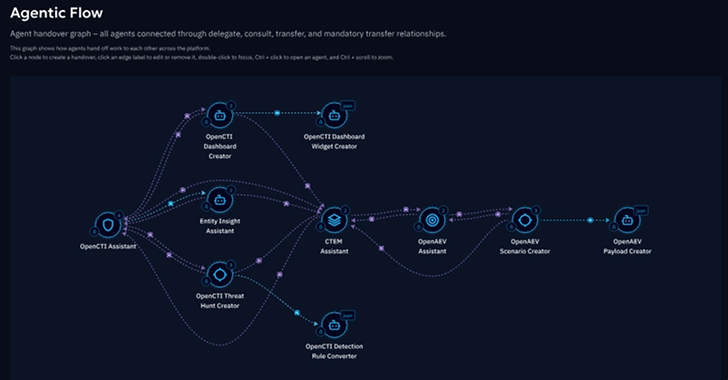
An Agentic threat management architecture is what makes the difference between a CTEM framework that lives in a strategy document and one that runs continuously in the background. This requires a dedicated AI orchestration layer that acts as a foundational, contextual layer with interconnected agents. Instead of analysts manually connecting threat intelligence to exposure validation, agents do the heavy lifting continuously and with the right context and reasoning. The whole workflow is autonomous, where agents handover tasks from one to another and across products while still keeping human-in-the-loop for final decision making. Analysts can truly become the orchestrator of intelligence-driven actions.
The security teams building this capability now aren’t waiting for a perfect toolset. They’re building the operational model first and letting the architecture catch up. The ones that get there first will have a structural advantage that compounds over time: better data, better analysis, better evidence, and furthermore, better-tuned AI. General purpose LLMs aren’t cut for this, it requires context and the product-based know-how.
The organizations closing it fastest are the ones treating CTEM as an operating model, not as a single tool, and choosing AI infrastructure built specifically to run it end-to-end. You can see the operational model at work with XTM One CTEM Assistant.
Watch It in Practice: Live Webinar
Filigran is running a live session that walks through what this looks like in practice: how security teams are using agentic AI to connect intelligence, exposure validation, and response into a single continuous workflow, without the handoff gaps that slow down every step in between.
The session will cover:
- Why the shift to agentic AI changes the operational model for security programs, not just the tooling
- Where purpose-built agents outperform general-purpose AI when precision matters
- How to evaluate agentic AI infrastructure for your own program
Register for a live session or get the recording:

