Close Menu
  • Home
  • News
  • Cyber Security
  • Internet of Things
  • Tips and Advice

Subscribe to Updates

Get the latest creative news from FooBar about art, design and business.

What's Hot

Badges, Bytes and Blackmail

February 7, 2026

Ex-Google Engineer Convicted for Stealing AI Secrets for China Startup

February 7, 2026

Substack Confirms Data Breach, “Limited User Data” Compromised

February 6, 2026
Facebook X (Twitter) Instagram
Saturday, February 7
Facebook X (Twitter) Instagram Pinterest Vimeo
Cyberwire Daily
  • Home
  • News
  • Cyber Security
  • Internet of Things
  • Tips and Advice
Cyberwire Daily
Home»News»Ukraine Warns of CABINETRAT Backdoor + XLL Add-ins Spread via Signal ZIPs
News

Ukraine Warns of CABINETRAT Backdoor + XLL Add-ins Spread via Signal ZIPs

Team-CWDBy Team-CWDOctober 9, 2025No Comments2 Mins Read
Share Facebook Twitter Pinterest LinkedIn Tumblr Reddit Telegram Email
Share
Facebook Twitter LinkedIn Pinterest Email


The Computer Emergency Response Team of Ukraine (CERT-UA) has warned of new targeted cyber attacks in the country using a backdoor called CABINETRAT.

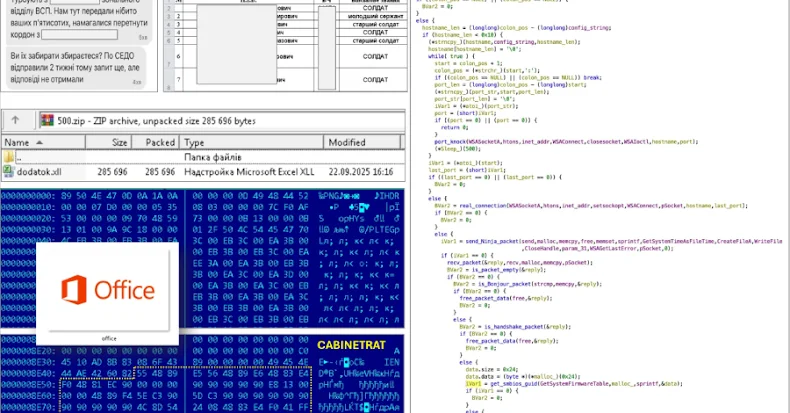
The activity, observed in September 2025, has been attributed to a threat cluster it tracks as UAC-0245. The agency said it spotted the attack following the discovery of software tools taking the form of XLL files, which refer to Microsoft Excel add-ins that are typically used to extend the functionality of Excel with custom functions.

Further investigation has uncovered that the XLL files are distributed within ZIP archives shared on the Signal messaging app, disguised as a document concerning the detention of individuals who had attempted to cross the Ukrainian border.

The XLL, once launched, is designed to create a number of executables on the compromised host, namely an EXE file in the Startup folder, an XLL file named “BasicExcelMath.xll” in the “%APPDATA%MicrosoftExcelXLSTART” directory, and a PNG image named “Office.png.”

Windows Registry modifications are done to ensure persistence of the executable, after which it launches the Excel application (“excel.exe”) with the “/e” (“/embed”) parameter in hidden mode in order to ultimately run the XLL add-in. The main purpose of the XLL is to parse and extract from the PNG file shellcode that’s classified as CABINETRAT.

Both the XLL payload and the shellcode come with a number of anti-VM and anti-analysis procedures to evade detection, including checking for at least two processor cores and at least 3GB of RAM, and the presence of tools like VMware, VirtualBox, Xen, QEMU, Parallels, and Hyper-V.

A full-fledged backdoor written in the C programming language, CABINETRAT is mainly designed to gather system information, a list of installed programs, screenshots, as well as enumerate directory contents, deleting specific files or directories, running commands, and carrying out file uploads/downloads. It communicates with a remote server over a TCP connection.

The disclosure comes days after Fortinet FortiGuard Labs warned of attacks targeting Ukraine by impersonating the National Police of Ukraine in a fileless phishing campaign that delivers Amatera Stealer and PureMiner for harvesting sensitive data and mining cryptocurrency from targeted systems.


Source

computer security cyber attacks cyber news cyber security news cyber security news today cyber security updates cyber updates data breach hacker news hacking news how to hack information security network security ransomware malware software vulnerability the hacker news
Share. Facebook Twitter Pinterest LinkedIn Tumblr Email
Previous ArticleResearchers Warn of Security Gaps in AI Browsers
Next Article ClayRat Spyware Campaign Targets Android Users in Russia
Team-CWD
  • Website

Related Posts

News

Badges, Bytes and Blackmail

February 7, 2026
News

Ex-Google Engineer Convicted for Stealing AI Secrets for China Startup

February 7, 2026
News

Substack Confirms Data Breach, “Limited User Data” Compromised

February 6, 2026
Add A Comment
Leave A Reply Cancel Reply

Latest News

North Korean Hackers Turn JSON Services into Covert Malware Delivery Channels

November 24, 202522 Views

macOS Stealer Campaign Uses “Cracked” App Lures to Bypass Apple Securi

September 7, 202517 Views

North Korean Hackers Exploit Threat Intel Platforms For Phishing

September 7, 20256 Views

U.S. Treasury Sanctions DPRK IT-Worker Scheme, Exposing $600K Crypto Transfers and $1M+ Profits

September 5, 20256 Views

Ukrainian Ransomware Fugitive Added to Europe’s Most Wanted

September 11, 20255 Views
Stay In Touch
  • Facebook
  • YouTube
  • TikTok
  • WhatsApp
  • Twitter
  • Instagram
Most Popular

North Korean Hackers Turn JSON Services into Covert Malware Delivery Channels

November 24, 202522 Views

macOS Stealer Campaign Uses “Cracked” App Lures to Bypass Apple Securi

September 7, 202517 Views

North Korean Hackers Exploit Threat Intel Platforms For Phishing

September 7, 20256 Views
Our Picks

Is it time for internet services to adopt identity verification?

January 14, 2026

Can password managers get hacked? Here’s what to know

November 14, 2025

How chatbots can help spread scams

October 14, 2025

Subscribe to Updates

Get the latest news from cyberwiredaily.com

Facebook X (Twitter) Instagram Pinterest
  • Home
  • Contact
  • Privacy Policy
  • Terms of Use
  • California Consumer Privacy Act (CCPA)
© 2026 All rights reserved.

Type above and press Enter to search. Press Esc to cancel.